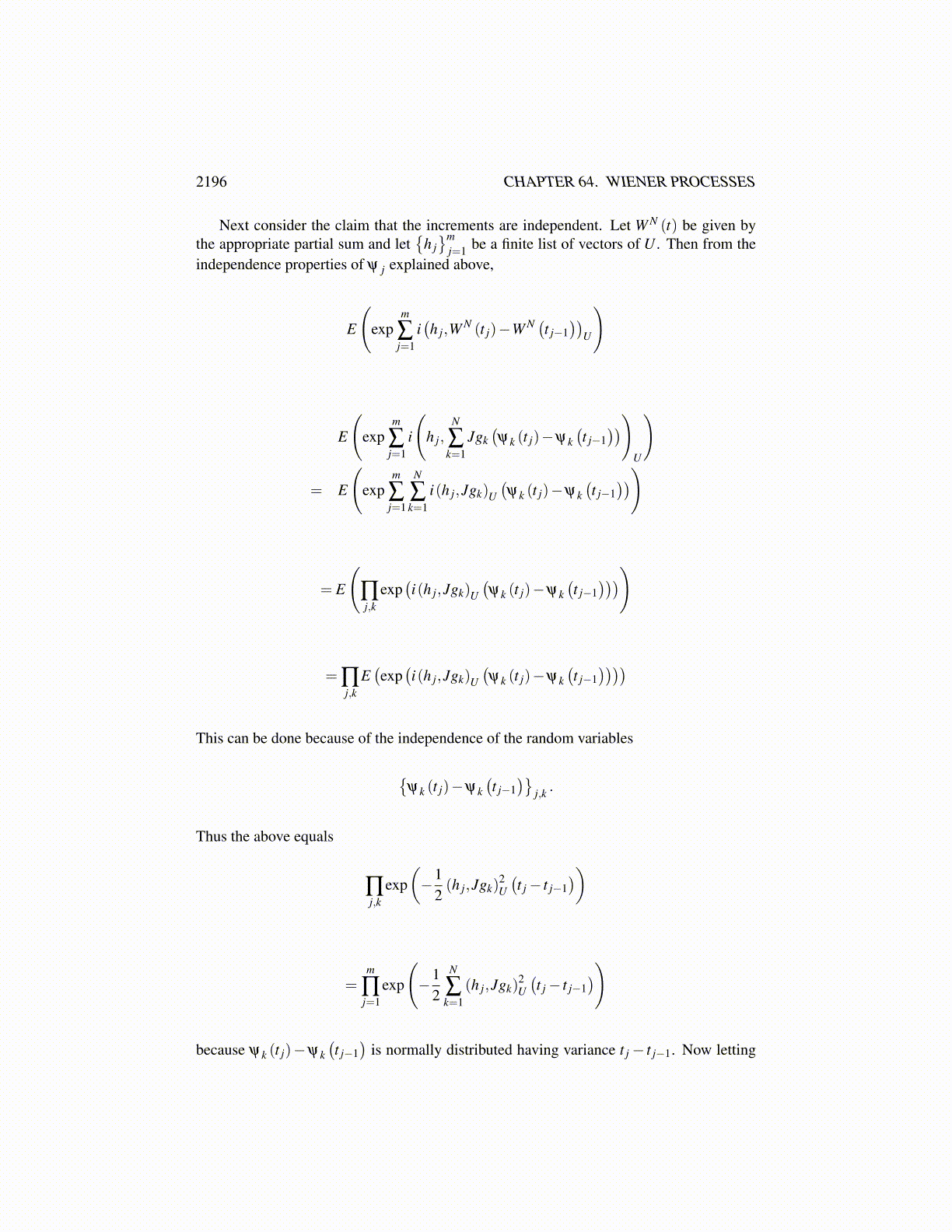
2196 CHAPTER 64. WIENER PROCESSES
= (t− s)n
∑k=m
(Jgk,Jgk) = (t− s)n
∑k=m||Jgk||2U
which converges to 0 as m,n→ ∞ thanks to the assumption that J is Hilbert Schmidt.It follows the above sum converges in L2 (Ω;U) . Now letting m < n, it follows by themaximal estimate, Theorem 62.5.3, and the above
P
([sup
t∈[0,T ]
∣∣∣∣∣ m
∑k=1
ψk (t)Jgk−n
∑k=1
ψk (t)Jgk
∣∣∣∣∣U
≥ λ
])
≤ 1
λ2 E
∣∣∣∣∣ n
∑k=m+1
ψk (T )Jgk
∣∣∣∣∣2
U
≤ 1
λ2 T
n
∑k=m||Jgk||2U
and so there exists a subsequence nl such that for all p≥ 0,
P
([sup
t∈[0,T ]
∣∣∣∣∣ nl
∑k=1
ψk (t)Jgk−nl+p
∑k=1
ψk (t)Jgk
∣∣∣∣∣U
≥ 2−l
])< 2−l
Therefore, by Borel Cantelli lemma, there is a set of measure zero such that for ω not inthis set,
liml→∞
nl
∑k=1
ψk (t)Jgk =∞
∑k=1
ψk (t)Jgk
is uniform on [0,T ]. From now on denote this subsequence by N to save on notation.I need to consider the characteristic function of (h,W (t)−W (s))U for h ∈U. Then
E (exp(ir (h,(W (t)−W (s)))U ))
= limN→∞
E
(exp
(ir
(N
∑j=1
(ψ j (t)−ψ j (s)
)(h,Jg j)
)))
= limN→∞
E
(N
∏j=1
eir(ψ j(t)−ψ j(s))(h,Jg j)
)Since the random variables ψ j (t)−ψ j (s) are independent,
= limN→∞
N
∏j=1
E(
eir(h,Jg j)(ψ j(t)−ψ j(s)))
Since ψ j (t)−ψ j (s) is a Gaussian random variable having mean 0 and variance (t− s), theabove equals
= limN→∞
N
∏j=1
e−12 r2(h,Jg j)
2(t−s)