64.6. WIENER PROCESSES, ANOTHER APPROACH 2217
You could also take an arbitrary f ∈ L2 (0,∞) and consider W (t) ≡W(X(0,t) f
). You
could consider this as an integral and write it in the notation
W (t)≡∫ t
0f dW ≡W
(f X(0,t)
)Then from the construction,
E
((∫ t
0f dW
)2)
= E(
W(
f X(0,t))2)=∫ T
0f 2X(0,t)ds =
∫ t
0| f |2 ds = E
(∫ t
0| f |2 ds
)because f does not depend on ω . This of course is formally the Ito isometry.
64.6.3 Q Wiener Processes In Hilbert SpaceNow let U be a real separable Hilbert space. Let an orthonormal basis for U be {gi}. Nowlet L2 (0,∞,U) be H in the above construction. For h,g ∈ L2 (0,∞,U) .
E (W (h)W (g)) = (h,g)L2(0,∞,U) ≡ (h,g)H
Here each W (g) will be a real valued normal random variable, the variance of W (g) is|g|2L2(0,∞,U) and its mean is 0, every vector (W (h1) , · · · ,W (hn)) being generalized multi-variate normal. Let
ψk (t) =W(X(0,t)gk
).
Then this is a real valued random variable. Disjoint increments are obviously independentin the same way as before. Also
E(
ψk (t)ψ j (s))= E
(W(X(0,t)gk
)W(X(0,s)g j
))≡∫
∞
0X(0,t∧s) (gk,g j)U dt = 0
(64.6.36)if j ̸= k. Thus the random variables ψk (t) and ψ j (s) are independent. This is because, from
the construction,(
ψk (t) ,ψ j (s))
is normally distributed and the covariance is a diagonalmatrix. Also
ψk (t)−ψk (s) =W(X(0,t)Jgk
)−W
(X(0,s)Jgk
)=W
(X(s,t)Jgk
)ψk (t− s)≡W
(X(0,t−s)Jgk
)so ψk (t− s) has the same mean, 0 and variance, |t− s| , as ψk (t)−ψs (s). Thus these havethe same distribution because both are normally distributed.
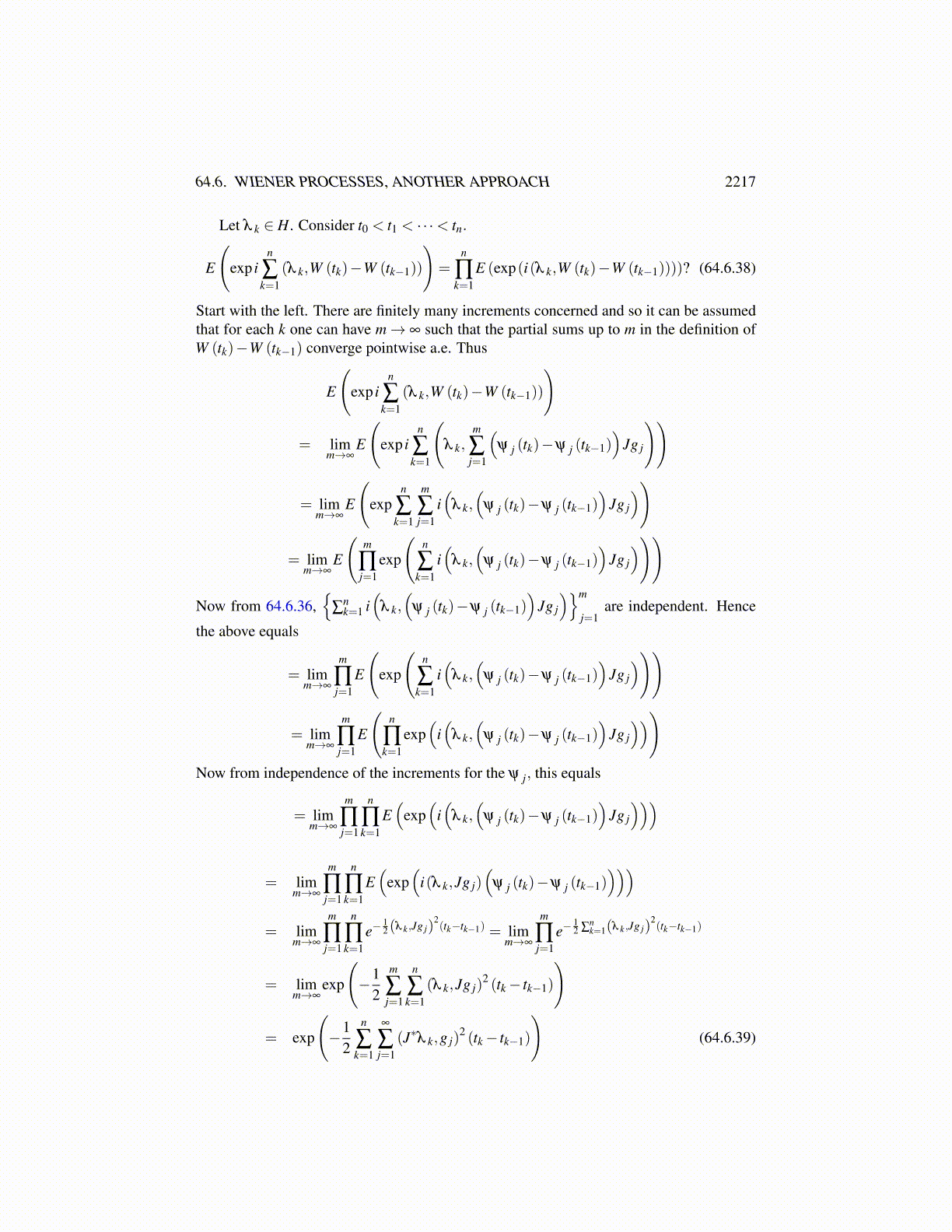
Now let J be a Hilbert Schmidt map from U to H. Then consider
W (t) = ∑k
ψk (t)Jgk. (64.6.37)
This has values in H. It is shown below that the series converges in L2 (Ω;H). Recall thedefinition of a Q Wiener process.