2218 CHAPTER 64. WIENER PROCESSES
Definition 64.6.7 Let W (t) be a stochastic process with values in H, a real separableHilbert space which has the properties that t →W (t,ω) is continuous, whenever t1 <t2 < · · ·< tm, the increments {W (ti)−W (ti−1)} are independent, W (0) = 0, and whenevers < t,
L (W (t)−W (s)) = N (0,(t− s)Q)
which means that whenever h ∈ H,
L ((h,W (t)−W (s))) = N (0,(t− s)(Qh,h))
AlsoE ((h1,W (t)−W (s))(h2,W (t)−W (s))) = (Qh1,h2)(t− s) .
Here Q is a nonnegative trace class operator. Recall this means
Q =∞
∑i=1
λ iei⊗ ei
where {ei} is a complete orthonormal basis, λ i ≥ 0, and
∞
∑i=1
λ i < ∞
Such a stochastic process is called a Q Wiener process. In the case where these have valuesin Rn, tQ ends up being the covariance matrix of W (t).
Proposition 64.6.8 The process defined in 64.6.37 is a Q Wiener process in H where Q =JJ∗.
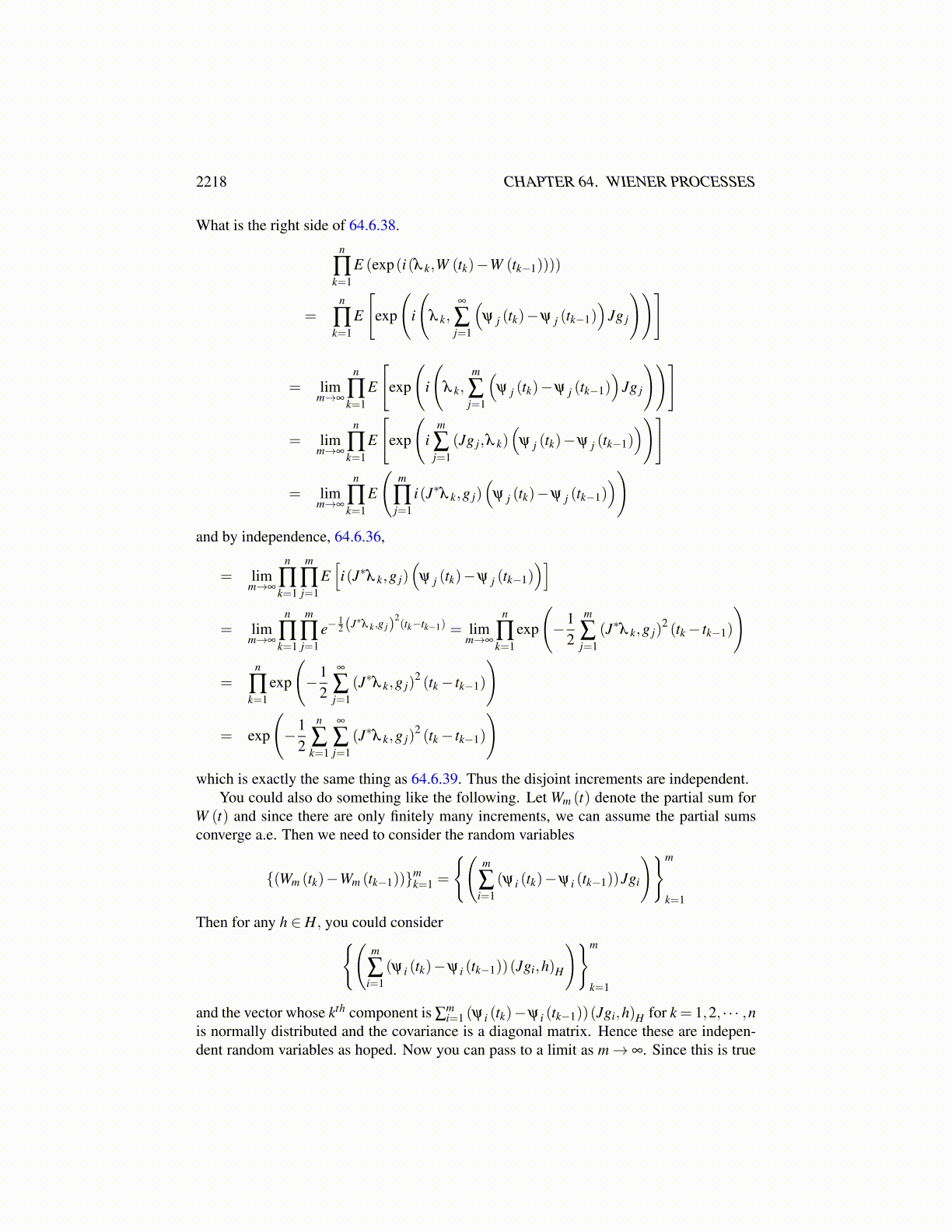
Proof: First, why does the sum converge? Consider the sum for an increment in time.Let ti−1 = 0 to obtain the convergence of the sum for a given t. Consider the difference oftwo partial sums.
E
(n
∑k,l=m
(ψk (ti)−ψk (ti−1))Jgk,(ψ l (ti)−ψ l (ti−1))Jgk
)
= E
(n
∑k,l=m
(J∗Jgk,gl)(ψk (ti)−ψk (ti−1))(ψ l (ti)−ψ l (ti−1))
)
=n
∑k,l=m
(J∗Jgk,gl)E ((ψk (ti)−ψk (ti−1))(ψ l (ti)−ψ l (ti−1)))
=n
∑k=m
(J∗Jgk,gk)E(
ψk (ti)−ψk (ti−1)2)=
n
∑k=m
(J∗Jgk,gk)(ti− ti−1)
=n
∑k=m|Jgk|2H (ti− ti−1)
and this converges to 0 as m,n→ ∞ since J is Hilbert Schmidt. Thus the sum converges inL2 (Ω,H). Why are the disjoint increments independent?