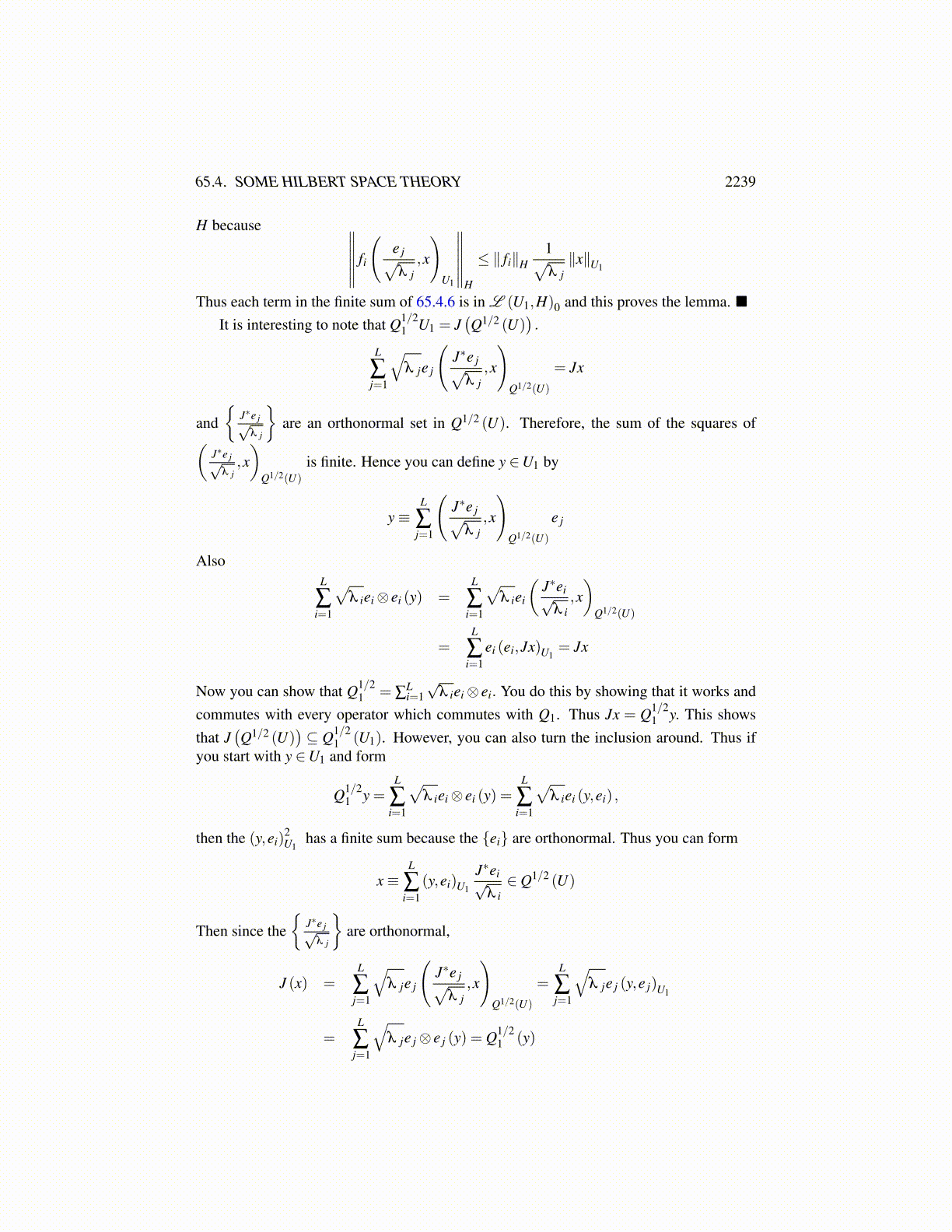
65.4. SOME HILBERT SPACE THEORY 2239
Then denote by L (U1,H)0 the space of restrictions of elements of L (U1,H) to the Hilbertspace JQ1/2U ⊆U1.
Here is a diagram to keep this straight.
U↓ Q1/2
U1 ⊇ JQ1/2U J←1−1
Q1/2U
Φn ↘ ↓ Φ
H
Lemma 65.4.5 In the context of the above definition, L (U1,H)0 is dense in
L2
(JQ1/2U,H
),
the Hilbert Schmidt operators from JQ1/2U to H. That is, if f ∈L2(JQ1/2U,H
), there
existsg ∈L (U1,H)0 ,∥g− f∥L2(JQ1/2U,H) < ε.
Proof: The operator JJ∗ ≡ Q1 : U1 →U1 is self adjoint and nonnegative. It is alsocompact because J is Hilbert Schmidt. Therefore, by Theorem 21.3.9 on Page 663,
Q1 =L
∑k=1
λ kek⊗ ek
where the λ k are decreasing and positive, the {ek} are an orthonormal basis for U1, and λ Lis the last positive λ j. (This is a lot like the singular value matrix in linear algebra.) Thusalso
Q1ek = λ kek
If the λ k are all positive, then L≡ ∞. Then for k ≤ L if L < ∞, k < ∞ otherwise,(J∗ek√
λ k,
J∗e j√λ j
)Q1/2(U)
=
(JJ∗ek√
λ k,
e j√λ j
)U1
=
(λ kek√
λ k,
e j√λ j
)U1
=
√λ k√λ j
δ k j = δ jk
Now in case L < ∞, J(Q1/2 (U)
)⊆ span(e1, · · · ,eL) . Here is why. First note that Q1 is one
to one on span(e1, · · · ,eL) and maps this space onto itself because Q1 maps ek to a nonzeromultiple of ek. Hence its restriction to this subspace has an inverse which does the same. Italso maps all of U1 to span(e1, · · · ,eL). This follows from the definition of Q1 given in theabove sum. For x ∈ Q1/2 (U) , Jx ∈U1 and so
JJ∗Jx = Q1 (Jx) ∈ span(e1, · · · ,eL)
Hence Jx ∈ Q−11 (span(e1, · · · ,eL)) ∈ span(e1, · · · ,eL) . Recall that J is one to one so there
is only one element of J−1x.