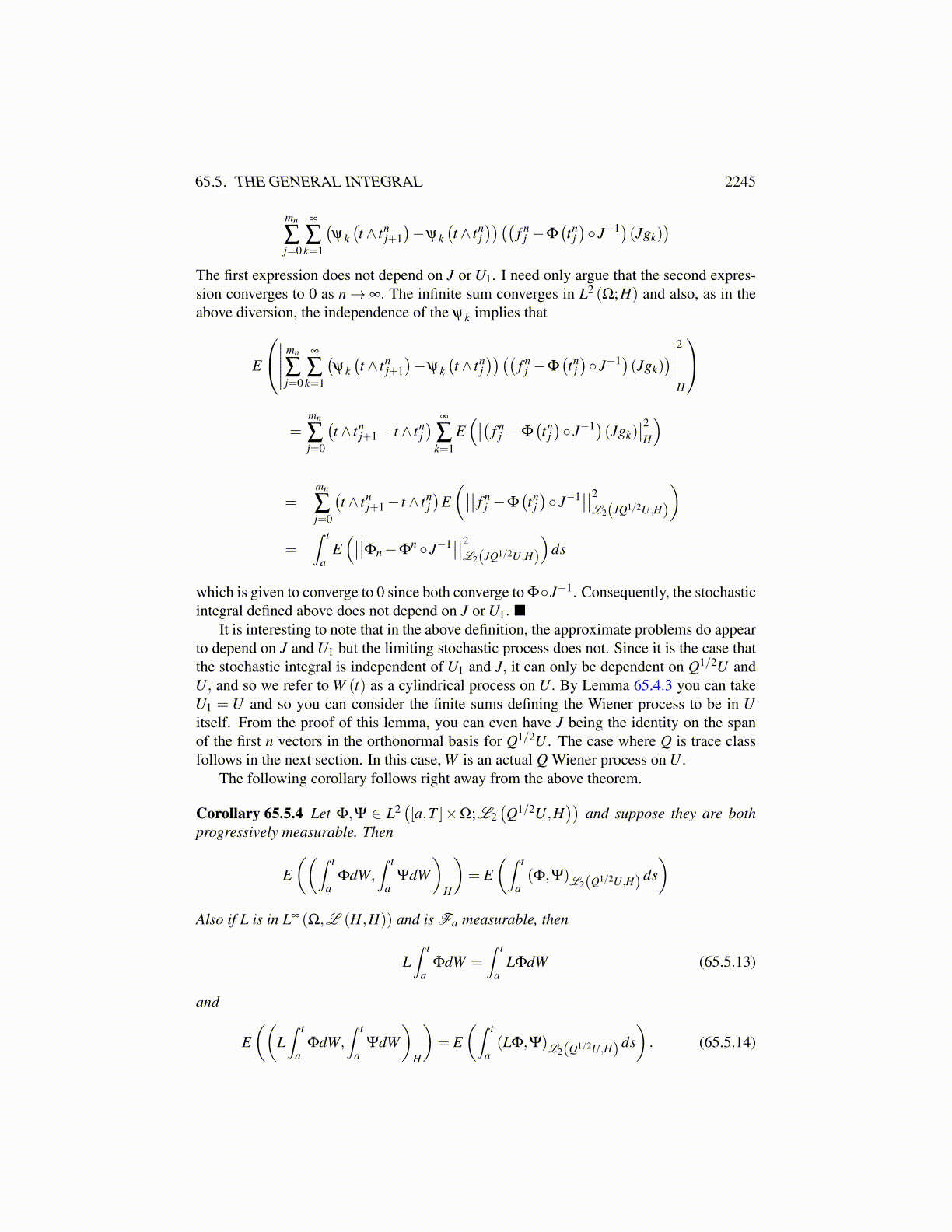
65.5. THE GENERAL INTEGRAL 2245
Why is it a martingale? Let s < t and A ∈Fs. Then∫A
(∫ t
aΦdW
)dP = lim
n→∞
∫A
(∫ t
aΦndW
)dP = lim
n→∞
∫A
E((∫ t
aΦndW
)|Fs
)dP
= limn→∞
∫A
(∫ s
aΦndW
)dP =
∫A
(∫ s
aΦdW
)dP
Hence this is a martingale as claimed.It remains to verify that the stochastic process does not depend on J and U1. Let the
approximating sequence of elementary functions be
Φn (t) =mn
∑j=0
f nj X(tn
j ,tnj+1]
(t)
where f nj is Ftn
jmeasurable and has finitely many values in L (U1,H)0 , the restrictions
of things in L (U1,H) to JQ1/2U . These are the elementary functions which converge toΦ◦ J−1. Also let the partitions be such that
Φn ◦ J−1 ≡
mn
∑j=0
Φ(tn
j)◦ J−1X(tn
j ,tnj+1]
(65.5.10)
converges to Φ◦ J−1 in L2([a,T ]×Ω;L2
(JQ1/2 (U) ,H
)). Then by definition,∫ t
aΦndW =
mn
∑j=0
f nj(W(t ∧ tn
j+1)−W
(t ∧ tn
j))
=mn
∑j=0
f nj
∞
∑k=1
(ψk(t ∧ tn
j+1)−ψk
(t ∧ tn
j))
Jgk
where {gk} is an orthonormal basis for Q1/2U. The infinite sum converges in L2 (Ω;U1)and f n
j is continuous on U1. Therefore, f nj can go inside the infinite sum, and this last
expression equals
=mn
∑j=0
∞
∑k=1
(ψk (t ∧ tk+1)−ψk (t ∧ tk)) f nj Jgk, (65.5.11)
the infinite sum converging in L2 (Ω,H).Now consider the left sum 65.5.10. Since Φ
(tn
j
)∈L2
(Q1/2U,H
), it follows that the
sum∞
∑k=1
(ψk(t ∧ tn
j+1)−ψk
(t ∧ tn
j))
Φ(tn
j)
gk
=∞
∑k=1
(ψk(t ∧ tn
j+1)−ψk
(t ∧ tn
j))
Φ(tn
j)◦ J−1 (Jgk) (65.5.12)
must converge in L2 (Ω,H) . Lets review why this is.