944 CHAPTER 26. INTEGRALS AND DERIVATIVES
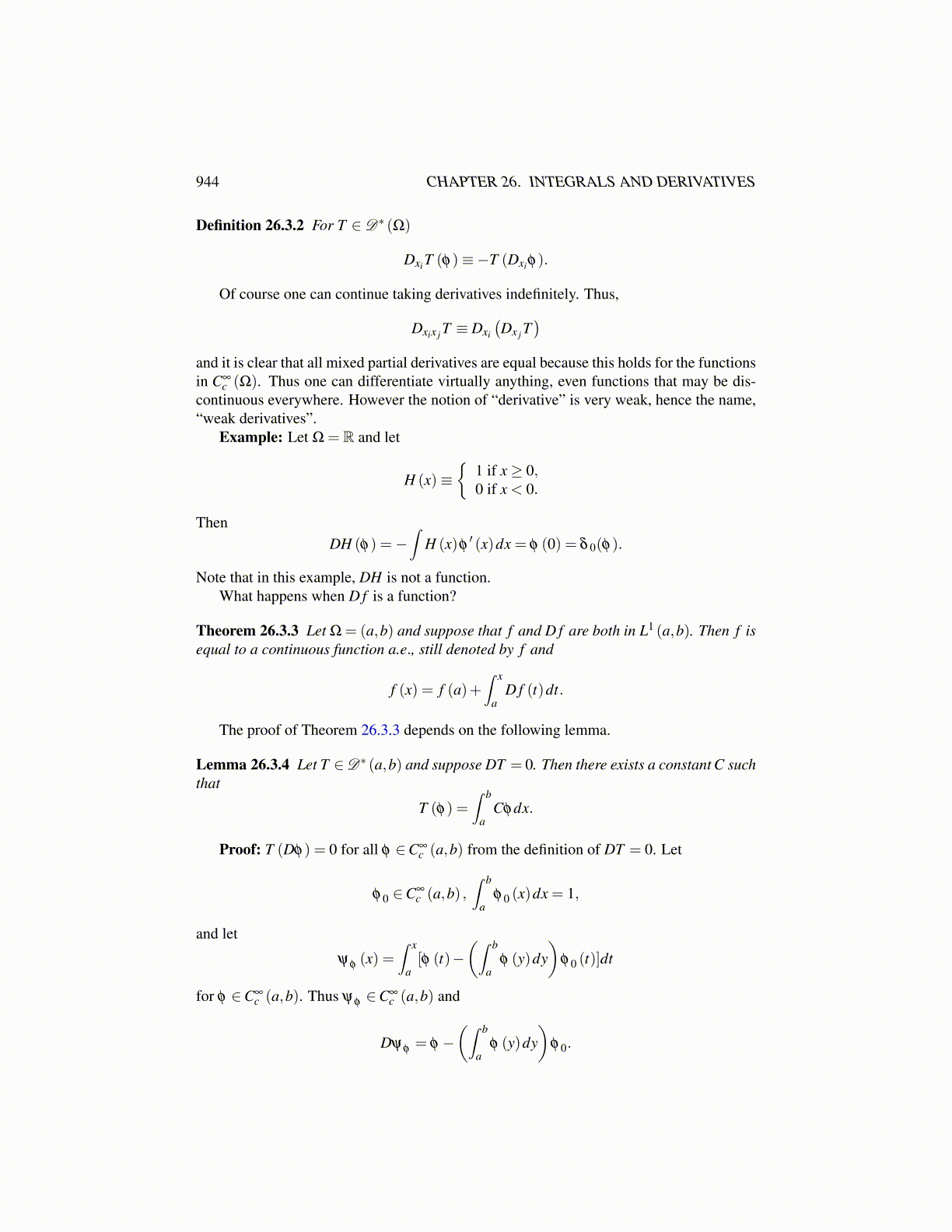
Definition 26.3.2 For T ∈D∗ (Ω)
DxiT (φ)≡−T (Dxiφ).
Of course one can continue taking derivatives indefinitely. Thus,
Dxix j T ≡ Dxi
(Dx j T
)and it is clear that all mixed partial derivatives are equal because this holds for the functionsin C∞
c (Ω). Thus one can differentiate virtually anything, even functions that may be dis-continuous everywhere. However the notion of “derivative” is very weak, hence the name,“weak derivatives”.
Example: Let Ω = R and let
H (x)≡{
1 if x≥ 0,0 if x < 0.
ThenDH (φ) =−
∫H (x)φ
′ (x)dx = φ (0) = δ 0(φ).
Note that in this example, DH is not a function.What happens when D f is a function?
Theorem 26.3.3 Let Ω = (a,b) and suppose that f and D f are both in L1 (a,b). Then f isequal to a continuous function a.e., still denoted by f and
f (x) = f (a)+∫ x
aD f (t)dt.
The proof of Theorem 26.3.3 depends on the following lemma.
Lemma 26.3.4 Let T ∈D∗ (a,b) and suppose DT = 0. Then there exists a constant C suchthat
T (φ) =∫ b
aCφdx.
Proof: T (Dφ) = 0 for all φ ∈C∞c (a,b) from the definition of DT = 0. Let
φ 0 ∈C∞c (a,b) ,
∫ b
aφ 0 (x)dx = 1,
and let
ψφ (x) =∫ x
a[φ (t)−
(∫ b
aφ (y)dy
)φ 0 (t)]dt
for φ ∈C∞c (a,b). Thus ψφ ∈C∞
c (a,b) and
Dψφ = φ −(∫ b
aφ (y)dy
)φ 0.