26.3. WEAK DERIVATIVES 945
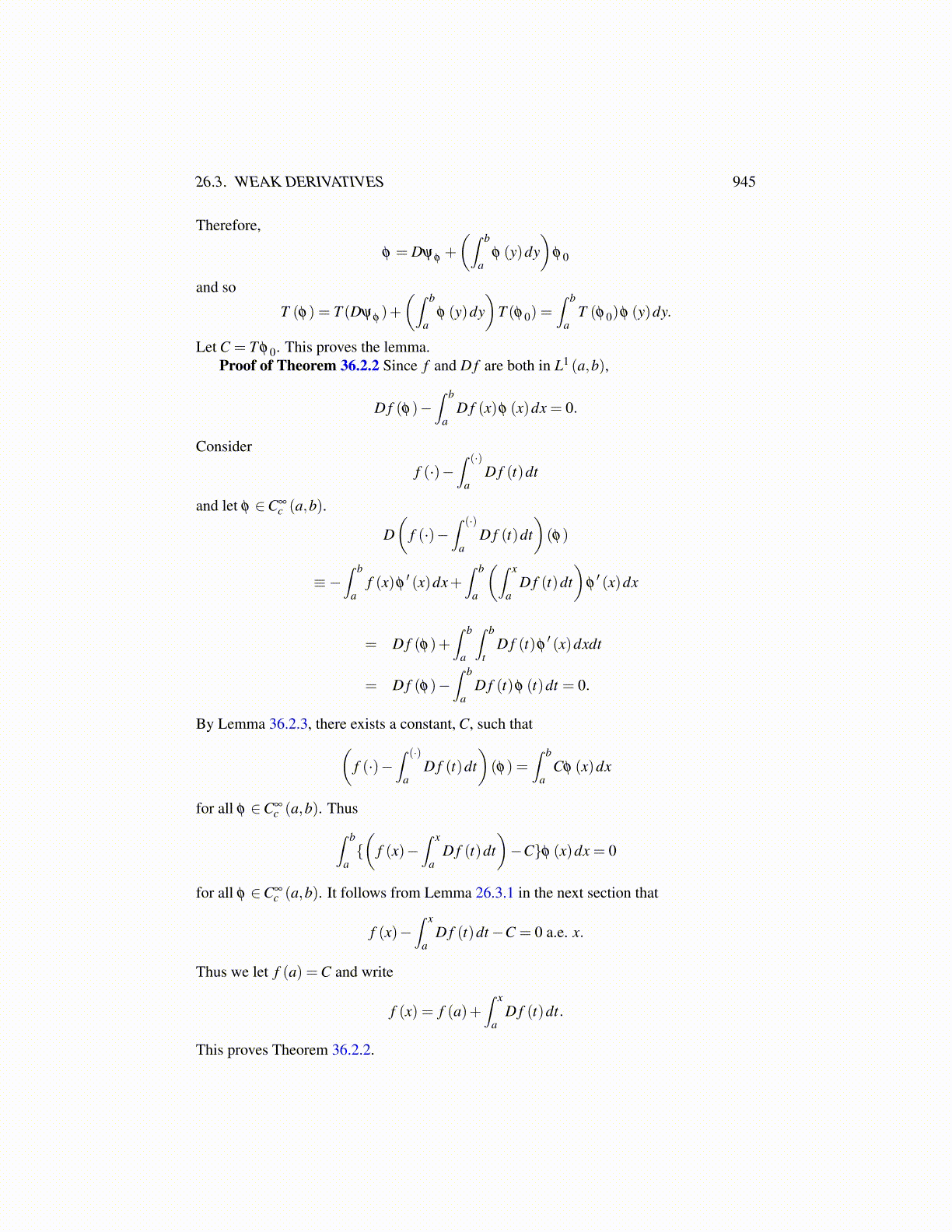
Therefore,
φ = Dψφ +
(∫ b
aφ (y)dy
)φ 0
and so
T (φ) = T (Dψφ )+
(∫ b
aφ (y)dy
)T (φ 0) =
∫ b
aT (φ 0)φ (y)dy.
Let C = T φ 0. This proves the lemma.Proof of Theorem 35.2.2 Since f and D f are both in L1 (a,b),
D f (φ)−∫ b
aD f (x)φ (x)dx = 0.
Consider
f (·)−∫ (·)
aD f (t)dt
and let φ ∈C∞c (a,b).
D(
f (·)−∫ (·)
aD f (t)dt
)(φ)
≡−∫ b
af (x)φ
′ (x)dx+∫ b
a
(∫ x
aD f (t)dt
)φ′ (x)dx
= D f (φ)+∫ b
a
∫ b
tD f (t)φ
′ (x)dxdt
= D f (φ)−∫ b
aD f (t)φ (t)dt = 0.
By Lemma 35.2.3, there exists a constant, C, such that(f (·)−
∫ (·)
aD f (t)dt
)(φ) =
∫ b
aCφ (x)dx
for all φ ∈C∞c (a,b). Thus∫ b
a{(
f (x)−∫ x
aD f (t)dt
)−C}φ (x)dx = 0
for all φ ∈C∞c (a,b). It follows from Lemma 26.3.1 in the next section that
f (x)−∫ x
aD f (t)dt−C = 0 a.e. x.
Thus we let f (a) =C and write
f (x) = f (a)+∫ x
aD f (t)dt.
This proves Theorem 35.2.2.