946 CHAPTER 26. INTEGRALS AND DERIVATIVES
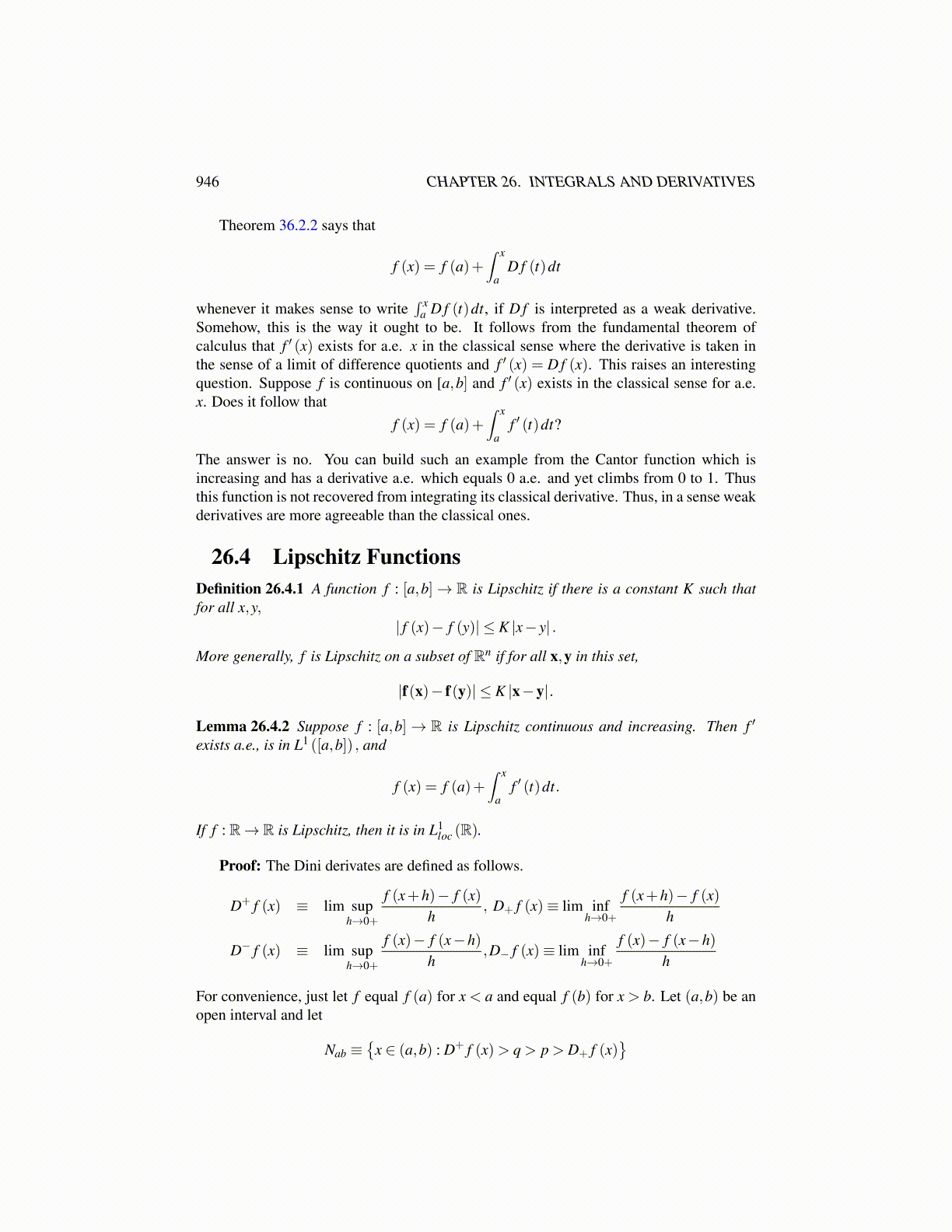
Theorem 35.2.2 says that
f (x) = f (a)+∫ x
aD f (t)dt
whenever it makes sense to write∫ x
a D f (t)dt, if D f is interpreted as a weak derivative.Somehow, this is the way it ought to be. It follows from the fundamental theorem ofcalculus that f ′ (x) exists for a.e. x in the classical sense where the derivative is taken inthe sense of a limit of difference quotients and f ′ (x) = D f (x). This raises an interestingquestion. Suppose f is continuous on [a,b] and f ′ (x) exists in the classical sense for a.e.x. Does it follow that
f (x) = f (a)+∫ x
af ′ (t)dt?
The answer is no. You can build such an example from the Cantor function which isincreasing and has a derivative a.e. which equals 0 a.e. and yet climbs from 0 to 1. Thusthis function is not recovered from integrating its classical derivative. Thus, in a sense weakderivatives are more agreeable than the classical ones.
26.4 Lipschitz FunctionsDefinition 26.4.1 A function f : [a,b]→ R is Lipschitz if there is a constant K such thatfor all x,y,
| f (x)− f (y)| ≤ K |x− y| .
More generally, f is Lipschitz on a subset of Rn if for all x,y in this set,
|f(x)− f(y)| ≤ K |x−y| .
Lemma 26.4.2 Suppose f : [a,b]→ R is Lipschitz continuous and increasing. Then f ′
exists a.e., is in L1 ([a,b]) , and
f (x) = f (a)+∫ x
af ′ (t)dt.
If f : R→ R is Lipschitz, then it is in L1loc (R).
Proof: The Dini derivates are defined as follows.
D+ f (x) ≡ lim suph→0+
f (x+h)− f (x)h
, D+ f (x)≡ lim infh→0+
f (x+h)− f (x)h
D− f (x) ≡ lim suph→0+
f (x)− f (x−h)h
,D− f (x)≡ lim infh→0+
f (x)− f (x−h)h
For convenience, just let f equal f (a) for x < a and equal f (b) for x > b. Let (a,b) be anopen interval and let
Nab ≡{
x ∈ (a,b) : D+ f (x)> q > p > D+ f (x)}