950 CHAPTER 26. INTEGRALS AND DERIVATIVES
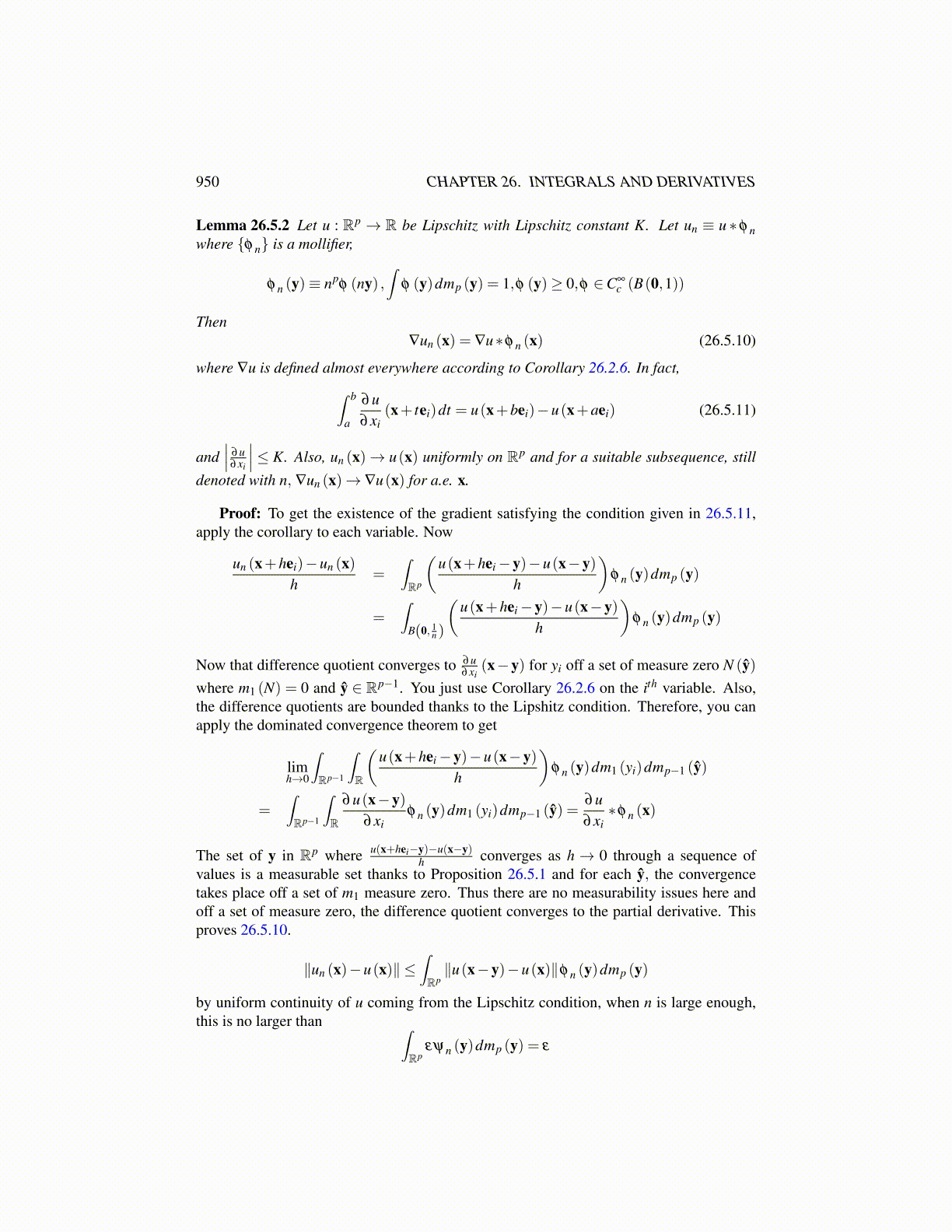
Lemma 26.5.2 Let u : Rp → R be Lipschitz with Lipschitz constant K. Let un ≡ u ∗ φ nwhere {φ n} is a mollifier,
φ n (y)≡ npφ (ny) ,
∫φ (y)dmp (y) = 1,φ (y)≥ 0,φ ∈C∞
c (B(0,1))
Then∇un (x) = ∇u∗φ n (x) (26.5.10)
where ∇u is defined almost everywhere according to Corollary 26.2.6. In fact,∫ b
a
∂u∂xi
(x+ tei)dt = u(x+bei)−u(x+aei) (26.5.11)
and∣∣∣ ∂u
∂xi
∣∣∣ ≤ K. Also, un (x)→ u(x) uniformly on Rp and for a suitable subsequence, still
denoted with n, ∇un (x)→ ∇u(x) for a.e. x.
Proof: To get the existence of the gradient satisfying the condition given in 26.5.11,apply the corollary to each variable. Now
un (x+hei)−un (x)h
=∫Rp
(u(x+hei−y)−u(x−y)
h
)φ n (y)dmp (y)
=∫
B(0, 1n )
(u(x+hei−y)−u(x−y)
h
)φ n (y)dmp (y)
Now that difference quotient converges to ∂u∂xi
(x−y) for yi off a set of measure zero N (ŷ)where m1 (N) = 0 and ŷ ∈ Rp−1. You just use Corollary 26.2.6 on the ith variable. Also,the difference quotients are bounded thanks to the Lipshitz condition. Therefore, you canapply the dominated convergence theorem to get
limh→0
∫Rp−1
∫R
(u(x+hei−y)−u(x−y)
h
)φ n (y)dm1 (yi)dmp−1 (ŷ)
=∫Rp−1
∫R
∂u(x−y)∂xi
φ n (y)dm1 (yi)dmp−1 (ŷ) =∂u∂xi∗φ n (x)
The set of y in Rp where u(x+hei−y)−u(x−y)h converges as h→ 0 through a sequence of
values is a measurable set thanks to Proposition 26.5.1 and for each ŷ, the convergencetakes place off a set of m1 measure zero. Thus there are no measurability issues here andoff a set of measure zero, the difference quotient converges to the partial derivative. Thisproves 26.5.10.
∥un (x)−u(x)∥ ≤∫Rp∥u(x−y)−u(x)∥φ n (y)dmp (y)
by uniform continuity of u coming from the Lipschitz condition, when n is large enough,this is no larger than ∫
Rpεψn (y)dmp (y) = ε