26.5. RADEMACHER’S THEOREM 951
and so uniform convergence holds.Now consider the last claim. From the first part,
∥unxi (x)−uxi (x)∥ =
∥∥∥∥∥∫
B(0, 1n )
uxi (x−y)φ n (y)dmp (y)−uxi (x)
∥∥∥∥∥=
∥∥∥∥∥∫
B(x, 1n )
uxi (z)φ n (x− z)dmp (z)−uxi (x)
∥∥∥∥∥∥unxi (x)−uxi (x)∥ ≤
∫Rp∥uxi (x−y)−uxi (x)∥φ n (y)dmp (y)
=∫
B(0, 1n )∥uxi (x−y)−uxi (x)∥φ n (y)dmp (y)
Now φ n (y) = npφ (ny) = mp(B(0,1))mp(B(0, 1
n ))φ (ny) . Therefore, the above equals
=mp (B(0,1))mp(B(0, 1
n
)) ∫B(0, 1
n )∥uxi (x−y)−uxi (x)∥φ (ny)dmp (y)
=mp (B(0,1))mp(B(0, 1
n
)) ∫B(x, 1
n )∥uxi (z)−uxi (x)∥φ (n(x− z))dmp (z)
≤ Cmp (B(0,1))mp(B(x, 1
n
)) ∫B(x, 1
n )∥uxi (z)−uxi (x)∥dmp (z)
which converges to 0 for a.e. x, in fact at any Lebesgue point. This is because uxi is boundedby K and so is in L1
loc.The following lemma gives an interesting inequality due to Morrey. To simplify nota-
tion dz will mean dmp (z).
Lemma 26.5.3 Let u be a C1 function on Rp. Then there exists a constant C, dependingonly on p such that for any x, y ∈ Rp,
|u(x)−u(y)|
≤C(∫
B(x,2|x−y|)|∇u(z) |qdz
)1/q(| x− y|(1−p/q)
). (26.5.12)
Here q > p.
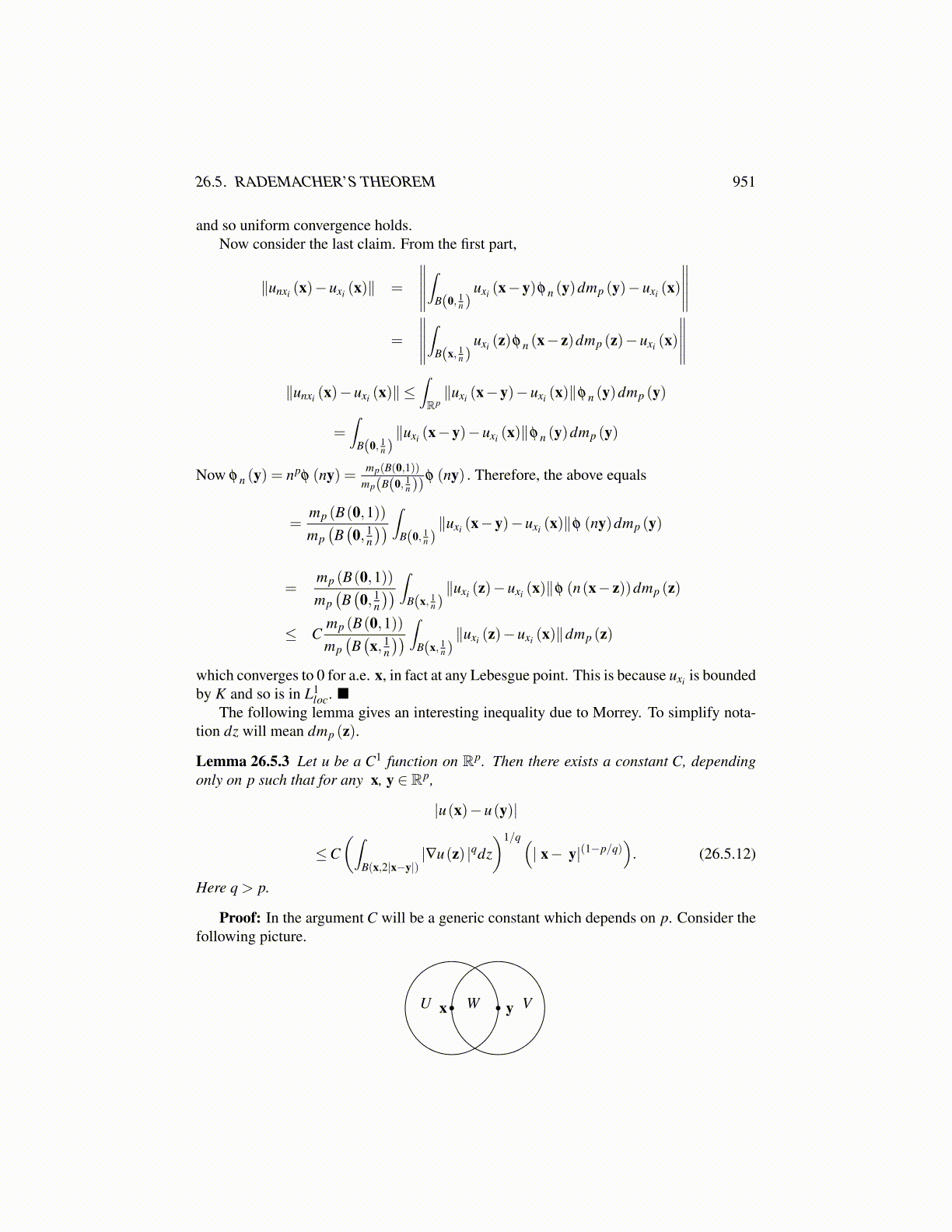
Proof: In the argument C will be a generic constant which depends on p. Consider thefollowing picture.
xU W Vy