26.8. EXERCISES 969

Hint: First assume both sets are bounded. This creates no loss of generality. Nextthere exist a0 ∈ A, b0 ∈ B and δ > 0 such that∫

B(a0,δ )XA (t)dt >

34

m(B(a0,δ )) ,∫

B(b0,δ )XB (t)dt >

34

m(B(b0,δ )) .

Now explain why this implies

m(A−a0∩B(0,δ ))>34

m(B(0,δ ))

andm(B−b0∩B(0,δ ))>

34

m(B(0,δ )) .

Explain why

m((A−a0)∩ (B−b0))>12

m(B(0,δ ))> 0.

Letf (x)≡

∫XA−a0 (x+ t)XB−b0 (t)dt.

Explain why f (0) > 0. Next explain why f is continuous and why f (x) > 0 for allx∈ B(0,ε) for some ε > 0. Thus if |x|< ε, there exists t such that x+ t∈ A−a0 andt ∈ B−b0. Subtract these.

2. Show M f is Borel measurable by verifying that [M f > λ ] ≡ Eλ is actually an openset. Hint: If x ∈ Eλ then for some r,

∫B(x,r) | f |dm > λm(B(x,r)) . Then for δ a small

enough positive number,∫

B(x,r) | f |dm > λm(B(x,r+2δ )) . Now pick y ∈ B(x,δ )and argue that B(y,δ + r)⊇ B(x,r) . Therefore show that,∫

B(y,δ+r)| f |dm >

∫B(x,r)

| f |dm > λB(x,r+2δ )≥ λm(B(y,r+δ )) .

Thus B(x,δ )⊆ Eλ .

3. Consider the following nested sequence of compact sets, {Pn}.Let P1 = [0,1], P2 =[0, 1

3

]∪[ 2

3 ,1], etc. To go from Pn to Pn+1, delete the open interval which is the

middle third of each closed interval in Pn. Let P = ∩∞n=1Pn. By the finite intersection

property of compact sets, P ̸= /0. Show m(P) = 0. If you feel ambitious also showthere is a one to one onto mapping of [0,1] to P. The set P is called the Cantorset. Thus, although P has measure zero, it has the same number of points in it as[0,1] in the sense that there is a one to one and onto mapping from one to the other.Hint: There are various ways of doing this last part but the most enlightenment isobtained by exploiting the topological properties of the Cantor set rather than somesilly representation in terms of sums of powers of two and three. All you need to dois use the Schroder Bernstein theorem and show there is an onto map from the Cantorset to [0,1]. If you do this right and remember the theorems about characterizationsof compact metric spaces, Proposition 7.6.5 on Page 144, you may get a pretty goodidea why every compact metric space is the continuous image of the Cantor set.

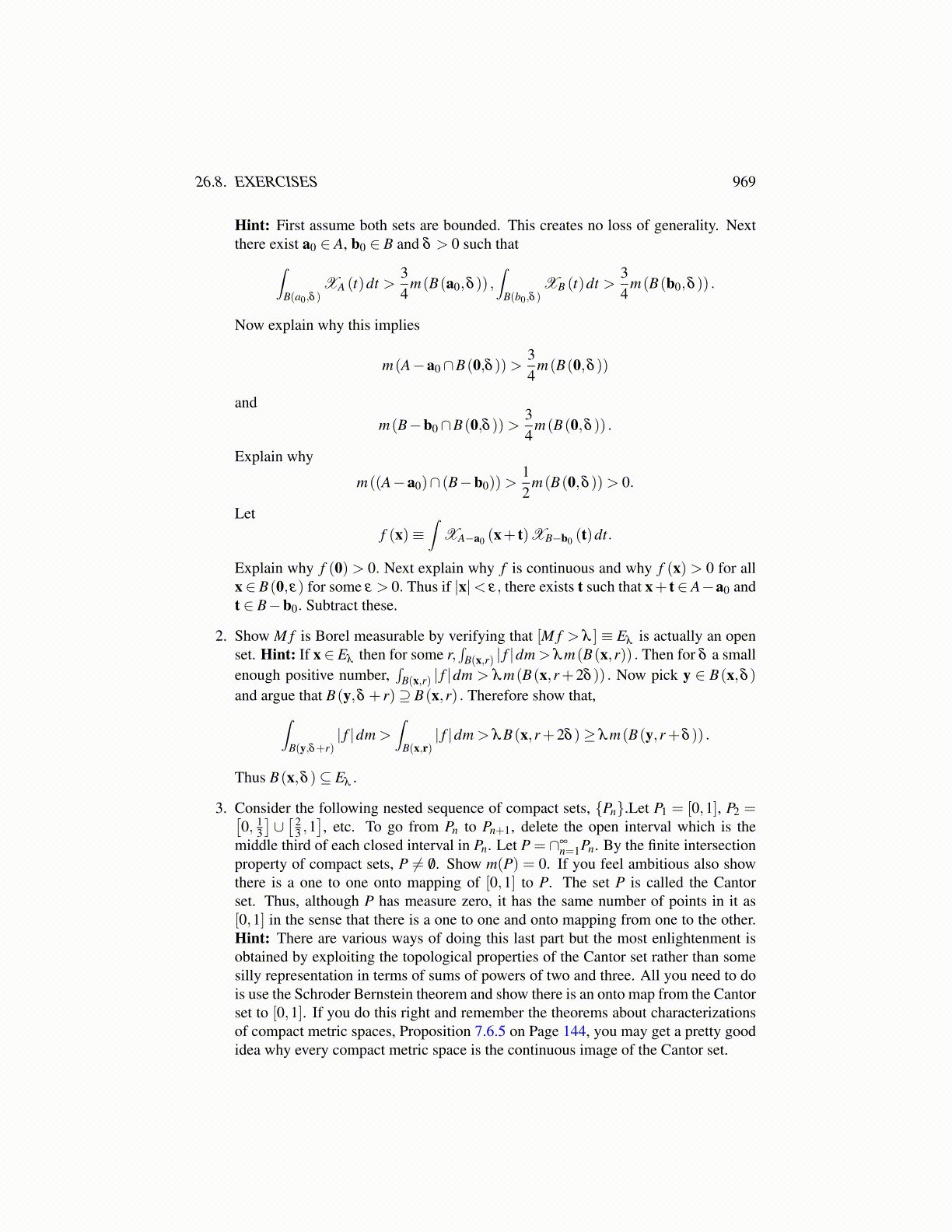
26.8. EXERCISES 969Hint: First assume both sets are bounded. This creates no loss of generality. Nextthere exist a9 € A, bo € B and 6 > O such that3 3Fx(thdt > Gm(B(ao,5)), | %vlt)dt > Fm(B(bo.5)).Thos 5) ZA > 7m (Bla0-8)). fg Malet > Fm(B (0-8)Now explain why this impliesm(A —ayB(0,6)) > “m(B(0,6))andm(B—boB(0,8)) > *m(B(0,8)).Explain whym((A—ao)(B—bo)) > 5" (B(0.8)) >0.Letf (x) = / Kaa (x+t) ZB_bo (t) dt.Explain why f (0) > 0. Next explain why f is continuous and why f (x) > 0 for allx € B(0,€) for some € > 0. Thus if |x| < €, there exists t such that x + t € A — ag andt € B—Dbo. Subtract these.2. Show Mf is Borel measurable by verifying that [Mf >A] = Ey is actually an openset. Hint: If x € E, then for some r, [pry ,) |f|dm > Am(B(x,r)). Then for 6 a smallenough positive number, fp, ,) |f|dm > Am(B(x,r+26)). Now pick y € B(x, 6)and argue that B(y,6 +r) D B(x,r). Therefore show that,| ifldm > | fldm > AB(x,r-+26) > Am(B(y,r+8)).B(y,6+r) B(x,r)Thus B(x,6) C Ej.3. Consider the following nested sequence of compact sets, {P,}.Let P; = [0,1], =(0, 3 U (4, 1], etc. To go from P, to P,41, delete the open interval which is themiddle third of each closed interval in P,. Let P =M?_, Py. By the finite intersectionproperty of compact sets, P #0. Show m(P) = 0. If you feel ambitious also showthere is a one to one onto mapping of [0,1] to P. The set P is called the Cantorset. Thus, although P has measure zero, it has the same number of points in it as[0, 1] in the sense that there is a one to one and onto mapping from one to the other.Hint: There are various ways of doing this last part but the most enlightenment isobtained by exploiting the topological properties of the Cantor set rather than somesilly representation in terms of sums of powers of two and three. All you need to dois use the Schroder Bernstein theorem and show there is an onto map from the Cantorset to [0,1]. If you do this right and remember the theorems about characterizationsof compact metric spaces, Proposition 7.6.5 on Page 144, you may get a pretty goodidea why every compact metric space is the continuous image of the Cantor set.