970 CHAPTER 26. INTEGRALS AND DERIVATIVES
4. Consider the sequence of functions defined in the following way. Let f1 (x) = x on[0,1]. To get from fn to fn+1, let fn+1 = fn on all intervals where fn is constant. Iffn is nonconstant on [a,b], let fn+1(a) = fn(a), fn+1(b) = fn(b), fn+1 is piecewiselinear and equal to 1
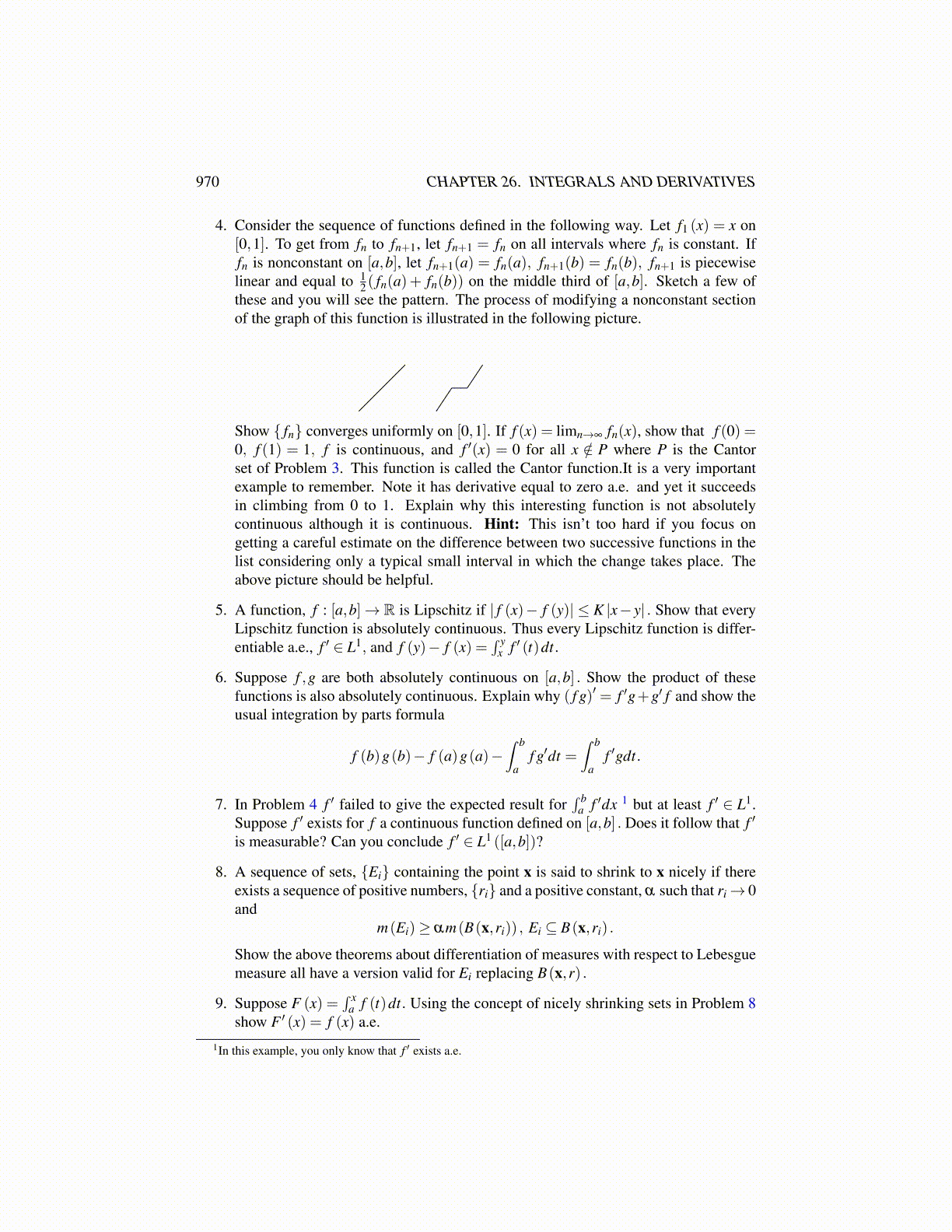
2 ( fn(a)+ fn(b)) on the middle third of [a,b]. Sketch a few ofthese and you will see the pattern. The process of modifying a nonconstant sectionof the graph of this function is illustrated in the following picture.
Show { fn} converges uniformly on [0,1]. If f (x) = limn→∞ fn(x), show that f (0) =0, f (1) = 1, f is continuous, and f ′(x) = 0 for all x /∈ P where P is the Cantorset of Problem 3. This function is called the Cantor function.It is a very importantexample to remember. Note it has derivative equal to zero a.e. and yet it succeedsin climbing from 0 to 1. Explain why this interesting function is not absolutelycontinuous although it is continuous. Hint: This isn’t too hard if you focus ongetting a careful estimate on the difference between two successive functions in thelist considering only a typical small interval in which the change takes place. Theabove picture should be helpful.
5. A function, f : [a,b]→ R is Lipschitz if | f (x)− f (y)| ≤ K |x− y| . Show that everyLipschitz function is absolutely continuous. Thus every Lipschitz function is differ-entiable a.e., f ′ ∈ L1, and f (y)− f (x) =
∫ yx f ′ (t)dt.
6. Suppose f ,g are both absolutely continuous on [a,b] . Show the product of thesefunctions is also absolutely continuous. Explain why ( f g)′ = f ′g+g′ f and show theusual integration by parts formula
f (b)g(b)− f (a)g(a)−∫ b
af g′dt =
∫ b
af ′gdt.
7. In Problem 4 f ′ failed to give the expected result for∫ b
a f ′dx 1 but at least f ′ ∈ L1.Suppose f ′ exists for f a continuous function defined on [a,b] . Does it follow that f ′
is measurable? Can you conclude f ′ ∈ L1 ([a,b])?
8. A sequence of sets, {Ei} containing the point x is said to shrink to x nicely if thereexists a sequence of positive numbers, {ri} and a positive constant, α such that ri→ 0and
m(Ei)≥ αm(B(x,ri)) , Ei ⊆ B(x,ri) .
Show the above theorems about differentiation of measures with respect to Lebesguemeasure all have a version valid for Ei replacing B(x,r) .
9. Suppose F (x) =∫ x
a f (t)dt. Using the concept of nicely shrinking sets in Problem 8show F ′ (x) = f (x) a.e.
1In this example, you only know that f ′ exists a.e.