Chapter 27
Orlitz Spaces27.1 Basic Theory
All the theorems about the Lp spaces have generalizations to something called an Orlitzspace. [1], [94] Instead of the convex function, A(t) = t p/p, one considers a more generalconvex increasing function called an N function.
Definition 27.1.1 A : [0,∞)→ [0,∞) is an N function if the following two conditions hold.
A is convex and strictly increasing (27.1.1)
limt→0+
A(t)t
= 0, limt→∞
A(t)t
= ∞. (27.1.2)
For A an N function,Ã(s)≡max{st−A(t) : t ≥ 0} . (27.1.3)
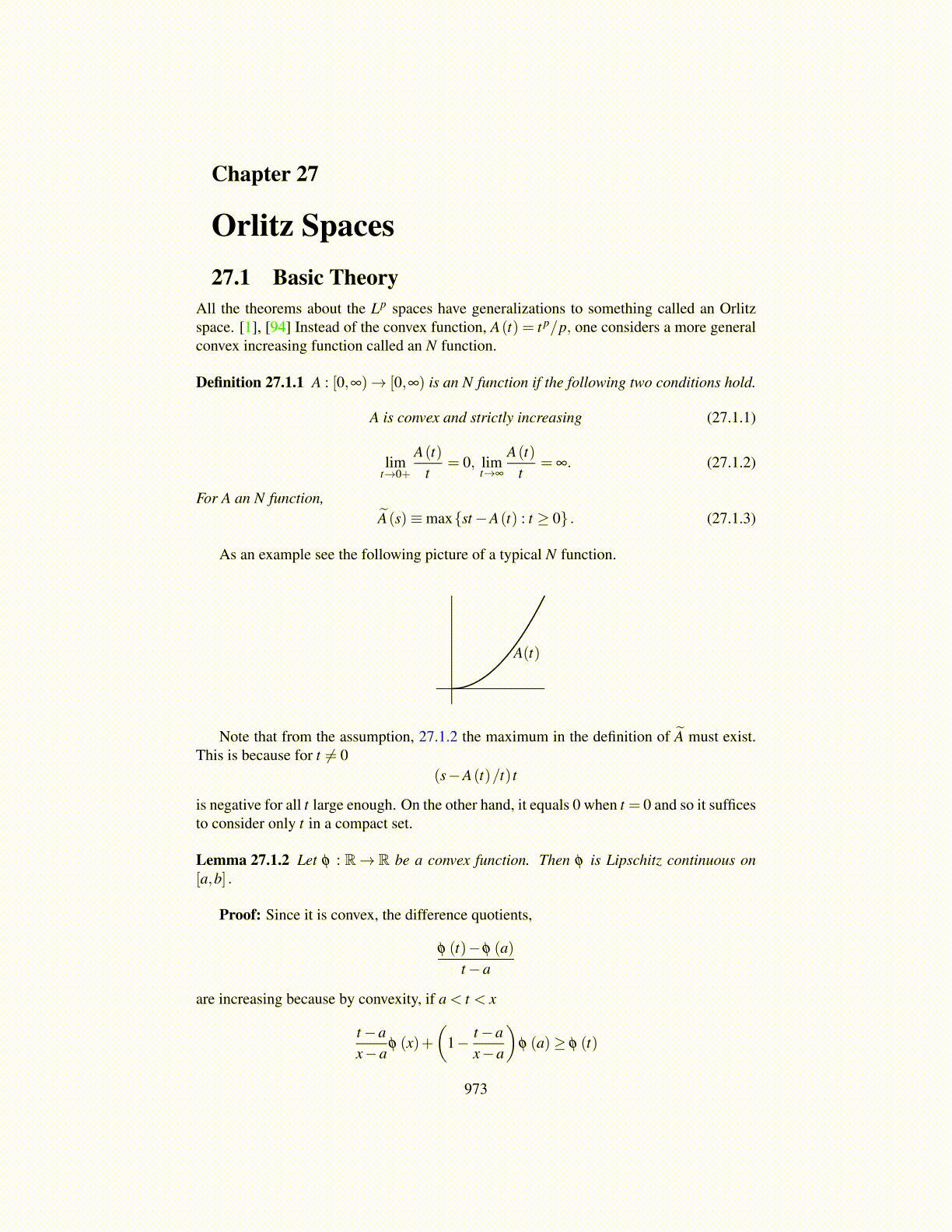
As an example see the following picture of a typical N function.
A(t)
Note that from the assumption, 27.1.2 the maximum in the definition of à must exist.This is because for t ̸= 0
(s−A(t)/t) t
is negative for all t large enough. On the other hand, it equals 0 when t = 0 and so it sufficesto consider only t in a compact set.
Lemma 27.1.2 Let φ : R→ R be a convex function. Then φ is Lipschitz continuous on[a,b] .
Proof: Since it is convex, the difference quotients,
φ (t)−φ (a)t−a
are increasing because by convexity, if a < t < x
t−ax−a
φ (x)+(
1− t−ax−a
)φ (a)≥ φ (t)
973