27.1. BASIC THEORY 977
and so(a(t)−a(s))(t− s)≥ 0.
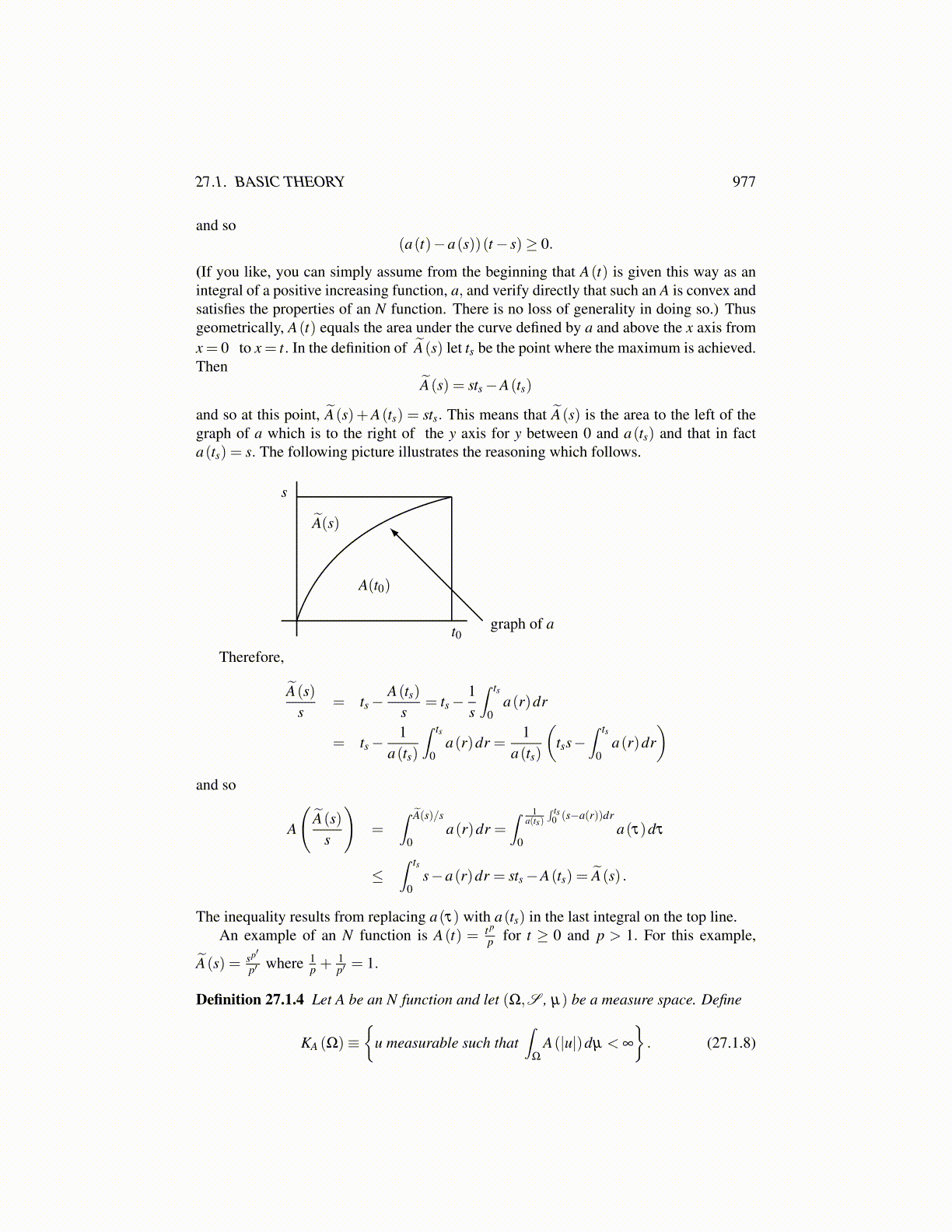
(If you like, you can simply assume from the beginning that A(t) is given this way as anintegral of a positive increasing function, a, and verify directly that such an A is convex andsatisfies the properties of an N function. There is no loss of generality in doing so.) Thusgeometrically, A(t) equals the area under the curve defined by a and above the x axis fromx = 0 to x = t. In the definition of Ã(s) let ts be the point where the maximum is achieved.Then
Ã(s) = sts−A(ts)
and so at this point, Ã(s)+A(ts) = sts. This means that Ã(s) is the area to the left of thegraph of a which is to the right of the y axis for y between 0 and a(ts) and that in facta(ts) = s. The following picture illustrates the reasoning which follows.
Ã(s)
t0
s
A(t0)
graph of a
Therefore,
Ã(s)s
= ts−A(ts)
s= ts−
1s
∫ ts
0a(r)dr
= ts−1
a(ts)
∫ ts
0a(r)dr =
1a(ts)
(tss−
∫ ts
0a(r)dr
)and so
A
(Ã(s)
s
)=
∫ Ã(s)/s
0a(r)dr =
∫ 1a(ts)
∫ ts0 (s−a(r))dr
0a(τ)dτ
≤∫ ts
0s−a(r)dr = sts−A(ts) = Ã(s) .
The inequality results from replacing a(τ) with a(ts) in the last integral on the top line.An example of an N function is A(t) = t p
p for t ≥ 0 and p > 1. For this example,
Ã(s) = sp′
p′ where 1p +
1p′ = 1.
Definition 27.1.4 Let A be an N function and let (Ω,S , µ) be a measure space. Define
KA (Ω)≡{
u measurable such that∫
Ω
A(|u|)dµ < ∞
}. (27.1.8)