976 CHAPTER 27. ORLITZ SPACES
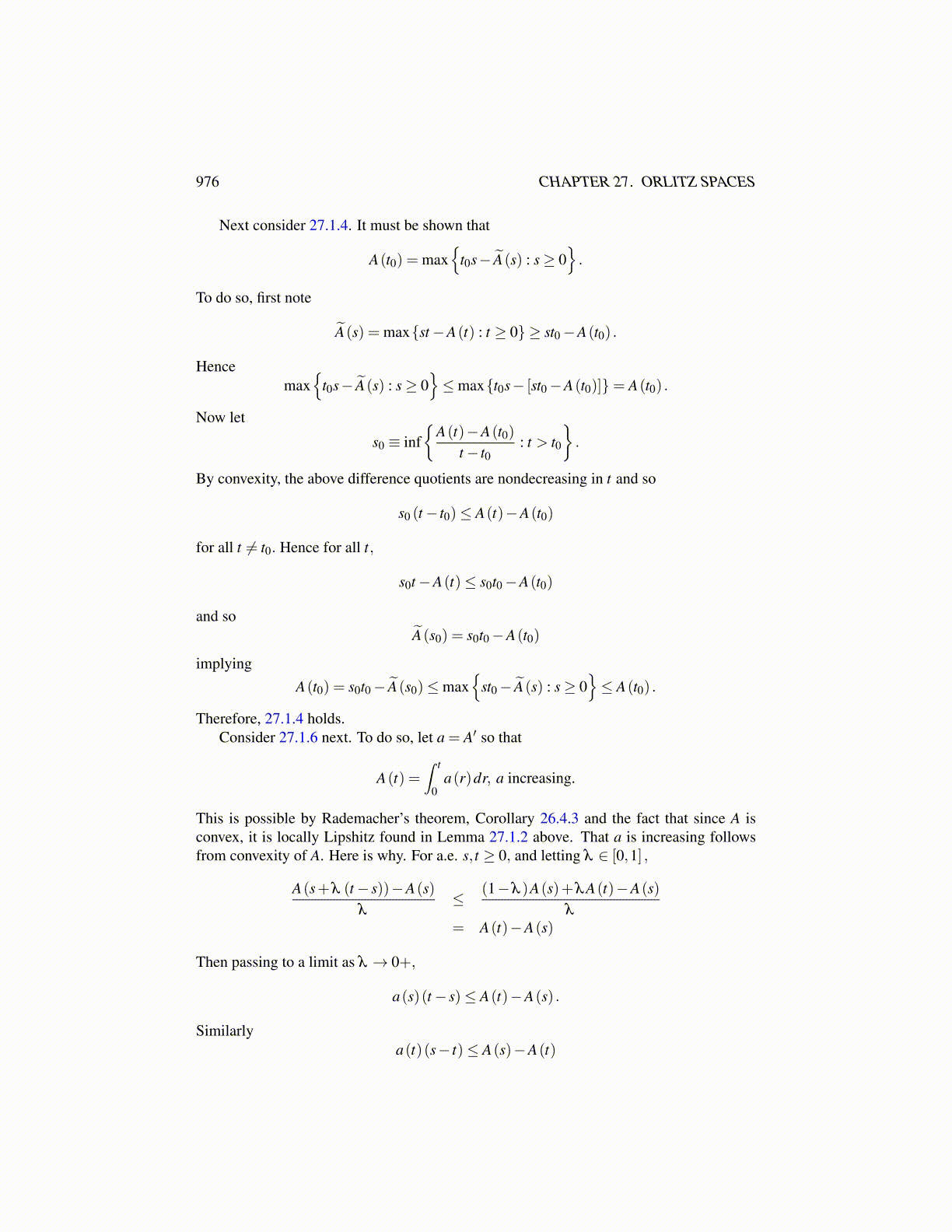
Next consider 27.1.4. It must be shown that
A(t0) = max{
t0s− Ã(s) : s≥ 0}.
To do so, first note
Ã(s) = max{st−A(t) : t ≥ 0} ≥ st0−A(t0) .
Hencemax
{t0s− Ã(s) : s≥ 0
}≤max{t0s− [st0−A(t0)]}= A(t0) .
Now let
s0 ≡ inf{
A(t)−A(t0)t− t0
: t > t0
}.
By convexity, the above difference quotients are nondecreasing in t and so
s0 (t− t0)≤ A(t)−A(t0)
for all t ̸= t0. Hence for all t,
s0t−A(t)≤ s0t0−A(t0)
and soÃ(s0) = s0t0−A(t0)
implyingA(t0) = s0t0− Ã(s0)≤max
{st0− Ã(s) : s≥ 0
}≤ A(t0) .
Therefore, 27.1.4 holds.Consider 27.1.6 next. To do so, let a = A′ so that
A(t) =∫ t
0a(r)dr, a increasing.
This is possible by Rademacher’s theorem, Corollary 26.4.3 and the fact that since A isconvex, it is locally Lipshitz found in Lemma 27.1.2 above. That a is increasing followsfrom convexity of A. Here is why. For a.e. s, t ≥ 0, and letting λ ∈ [0,1] ,
A(s+λ (t− s))−A(s)λ
≤ (1−λ )A(s)+λA(t)−A(s)λ
= A(t)−A(s)
Then passing to a limit as λ → 0+,
a(s)(t− s)≤ A(t)−A(s) .
Similarlya(t)(s− t)≤ A(s)−A(t)