27.1. BASIC THEORY 975
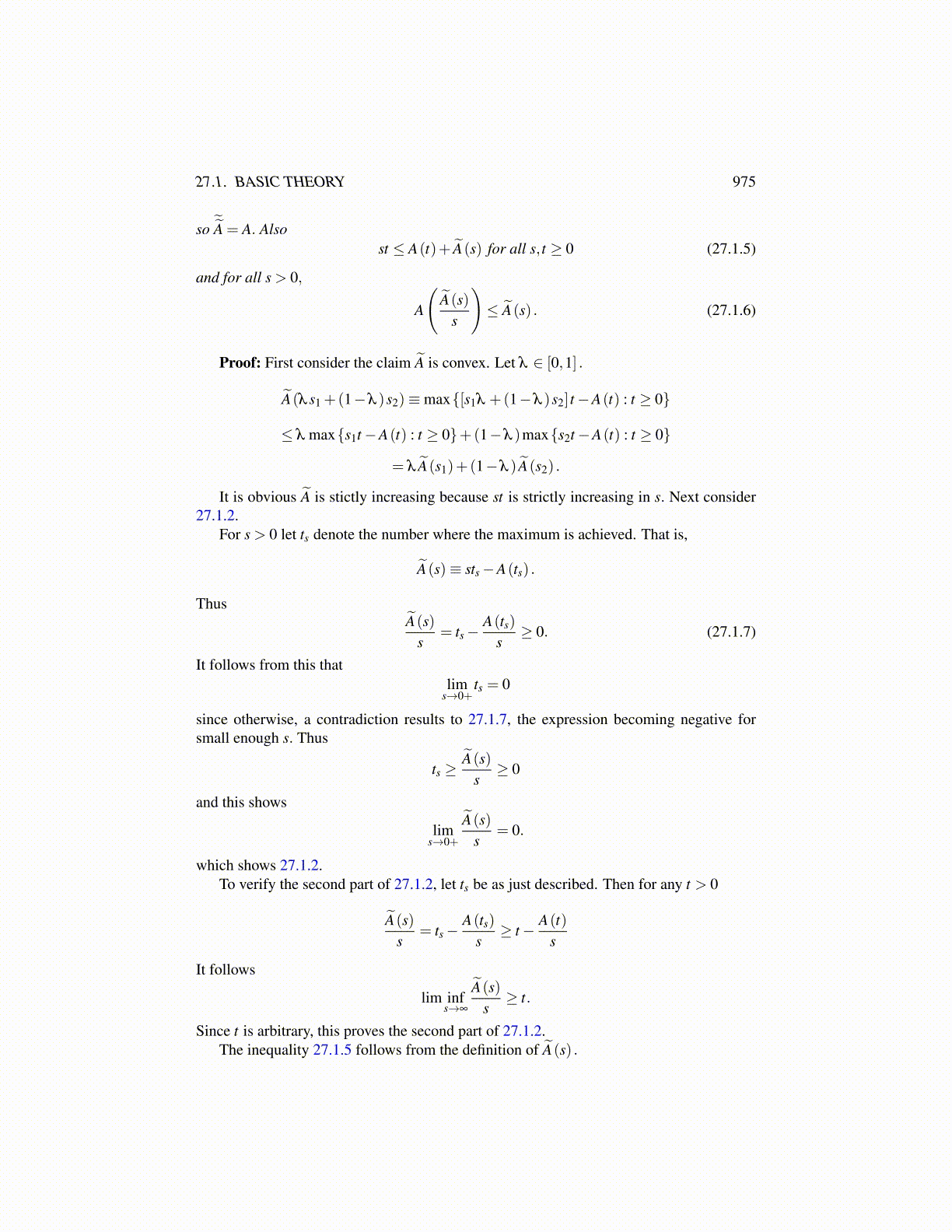
so ˜̃A = A. Alsost ≤ A(t)+ Ã(s) for all s, t ≥ 0 (27.1.5)
and for all s > 0,
A
(Ã(s)
s
)≤ Ã(s) . (27.1.6)
Proof: First consider the claim à is convex. Let λ ∈ [0,1] .
Ã(λ s1 +(1−λ )s2)≡max{[s1λ +(1−λ )s2] t−A(t) : t ≥ 0}
≤ λ max{s1t−A(t) : t ≥ 0}+(1−λ )max{s2t−A(t) : t ≥ 0}
= λ Ã(s1)+(1−λ ) Ã(s2) .
It is obvious à is stictly increasing because st is strictly increasing in s. Next consider27.1.2.
For s > 0 let ts denote the number where the maximum is achieved. That is,
Ã(s)≡ sts−A(ts) .
ThusÃ(s)
s= ts−
A(ts)s≥ 0. (27.1.7)
It follows from this thatlim
s→0+ts = 0
since otherwise, a contradiction results to 27.1.7, the expression becoming negative forsmall enough s. Thus
ts ≥Ã(s)
s≥ 0
and this shows
lims→0+
Ã(s)s
= 0.
which shows 27.1.2.To verify the second part of 27.1.2, let ts be as just described. Then for any t > 0
Ã(s)s
= ts−A(ts)
s≥ t− A(t)
s
It follows
lim infs→∞
Ã(s)s≥ t.
Since t is arbitrary, this proves the second part of 27.1.2.The inequality 27.1.5 follows from the definition of Ã(s) .