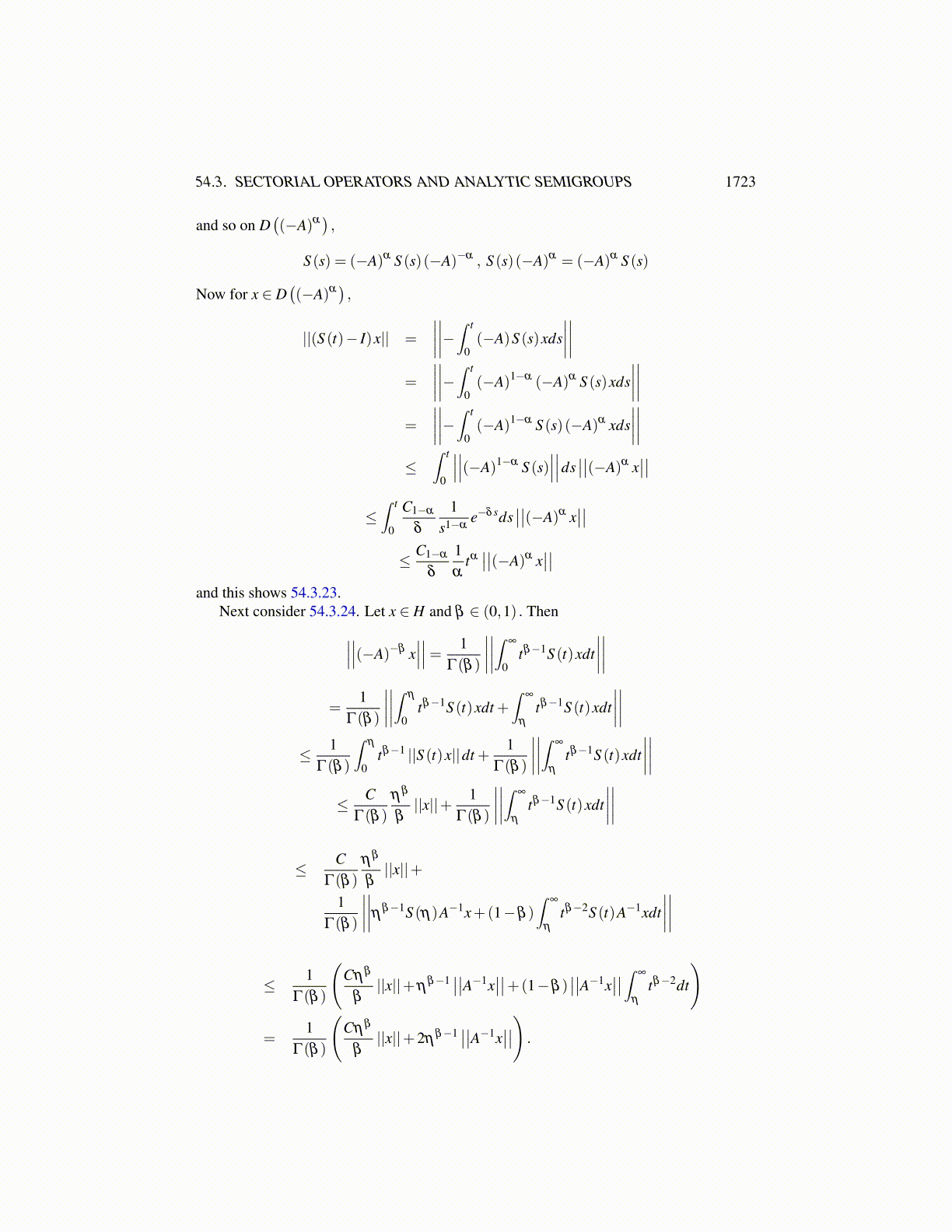
54.3. SECTORIAL OPERATORS AND ANALYTIC SEMIGROUPS 1723
There exists a constant C independent of α ∈ [0,1) such that for x ∈ D(A) and ε > 0,∣∣∣∣(−A)α x∣∣∣∣≤ ε ||(−A)x||+Cε
−α/(1−α) ||x|| (54.3.24)
There exists a constant C′ independent of α ∈ [0,1] such that for x ∈ D(A) ,∣∣∣∣(−A)α x∣∣∣∣≤C′ ||(−A)x||α ||x||1−α (54.3.25)
The formula 54.3.25 is called an interpolation inequality.
Proof: It is obvious (−A)α is densely defined because its domain is at least as large asD(A) which was assumed to be dense. It is a closed operator because if xn ∈ D
((−A)α
)and
xn→ x, (−A)α xn→ y,
then(−A)−α xn→ (−A)−α x, xn = (−A)−α (−A)α xn→ (−A)−α y
and so(−A)−α y = x
showing x ∈ D((−A)α
)and y = (−A)−α x. Thus (−A)α is closed and densely defined.
Let−δ >−a where the sector for A was S−a,φ ,a> 0. Then recall from Corollary 54.3.8there is a constant, N such that
||(−A)S (t)|| ≤ Nt
e−δ t
What about∣∣∣∣(−A)α S (t)
∣∣∣∣? First note that for α ∈ [0,1) this at least makes sense becauseS (t) maps into D(A). For any α > 0,
S (t)(−A)−α = (−A)−α S (t)
follows from the definiton of (−A)−α . Therefore,
(−A)α S (t)(−A)−α = S (t) . (54.3.26)
Note this implies that on D((−A)α
),
(−A)α S (t) = S (t)(−A)α .
Also(−A)−1 S (t) = S (t)(−A)−1 = S (t)(−A)−α (−A)−(1−α)
and soS (t) = (−A)S (t)(−A)−α (−A)−(1−α)
From 54.3.26 it follows
(−A)α S (t) = (−A)(−A)α S (t)(−A)−α (−A)−(1−α)
= (−A)S (t)(−A)−(1−α) (54.3.27)