64.3. WIENER PROCESSES IN SEPARABLE BANACH SPACE 2187
=n
∏q=1
m
∏r=1
E(exp(isqr(ψkr
(tq)−ψkr
(tq−1
))))because ψkr
(tq)−ψkr
(tq−1
)is normally distributed with variance tq− tq−1 and mean 0.
By Proposition 59.11.1 on Page 1891, it follows the random variables of 64.3.10 are inde-pendent. Note that as a special case, this also shows the random variables, {ψk (t)}
∞
k=1 areindependent due to the fact ψk (0) = 0.
Recall Corollary 61.11.4 which is stated here for convenience.
Corollary 64.3.2 Let E be any real separable Banach space. Then there exists a sequence,{ek} ⊆ E such that for any {ξ k} a sequence of independent random variables such thatL (ξ k) = N (0,1), it follows
X (ω)≡∞
∑k=1
ξ k (ω)ek
converges a.e. and its law is a Gaussian measure defined on B (E). Furthermore, ||ek||E ≤λ k where ∑k λ k < ∞.
Now let {ψk (t)} be the sequence of Wiener processes described in Lemma 64.3.1.Then define a process with values in E by
W (t)≡∞
∑k=1
ψk (t)ek (64.3.11)
Then ψk (t)/√
t is N (0,1) and so by Corollary 61.11.4 the law of
W (t)/√
t =∞
∑k=1
(ψk (t)/
√t)
ek
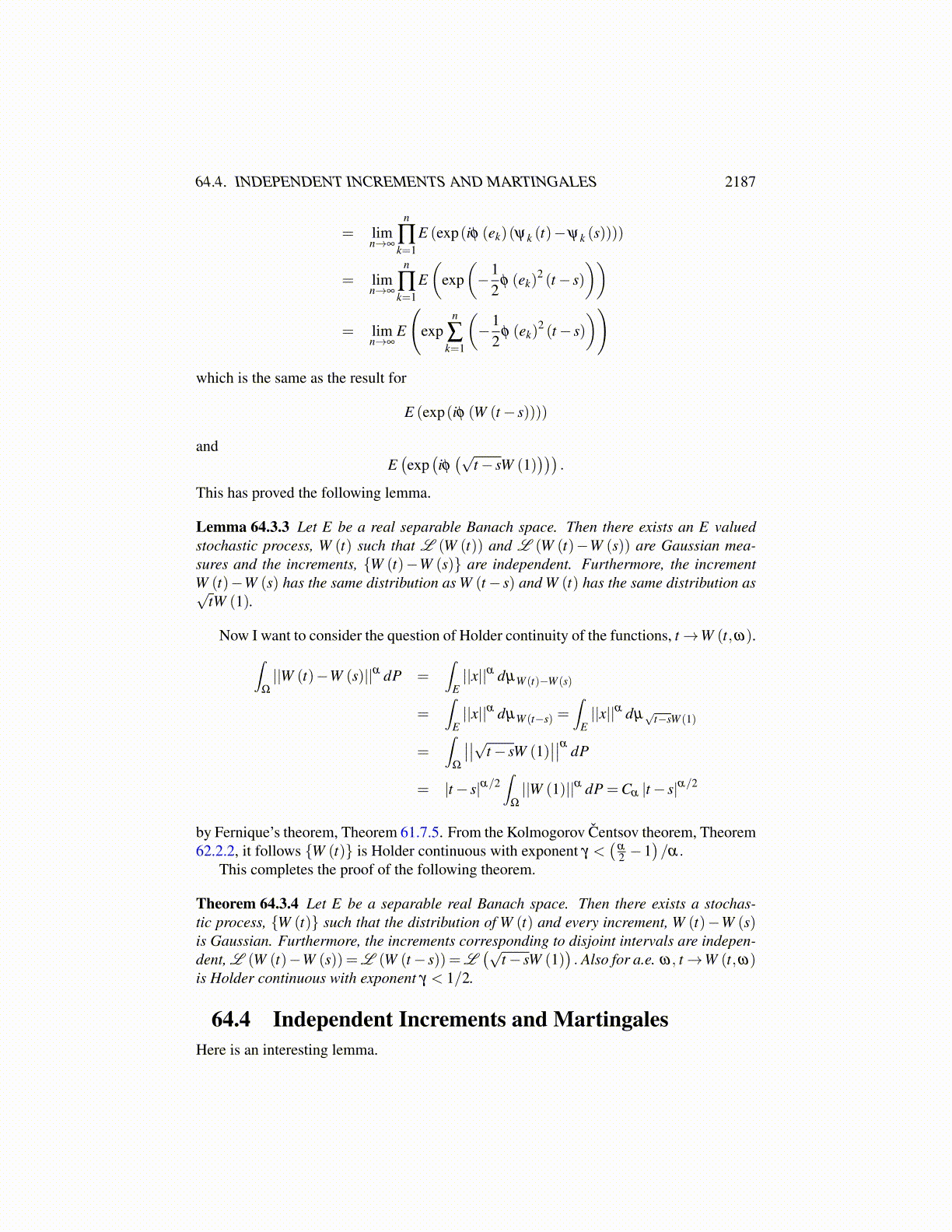
is a Gaussian measure. Therefore, the same is true of W (t) . Similar reasoning applies tothe increments, W (t)−W (s) to conclude the law of each of these is Gaussian. Considerthe question whether the increments are independent. Let 0 ≤ t0 < t1 < · · · < tm and letφ j ∈ E ′. Then by the dominated convergence theorem and the properties of the {ψk} ,
E
(exp
(i
m
∑j=1
φ j(W (t j)−W
(t j−1
))))
= E
(exp
(i
m
∑j=1
(∞
∑k=1
(ψk (t j)−ψk
(t j−1
))φ j (ek)
)))
= E
(m
∏j=1
exp
(i
∞
∑k=1
(ψk (t j)−ψk
(t j−1
))φ j (ek)
))