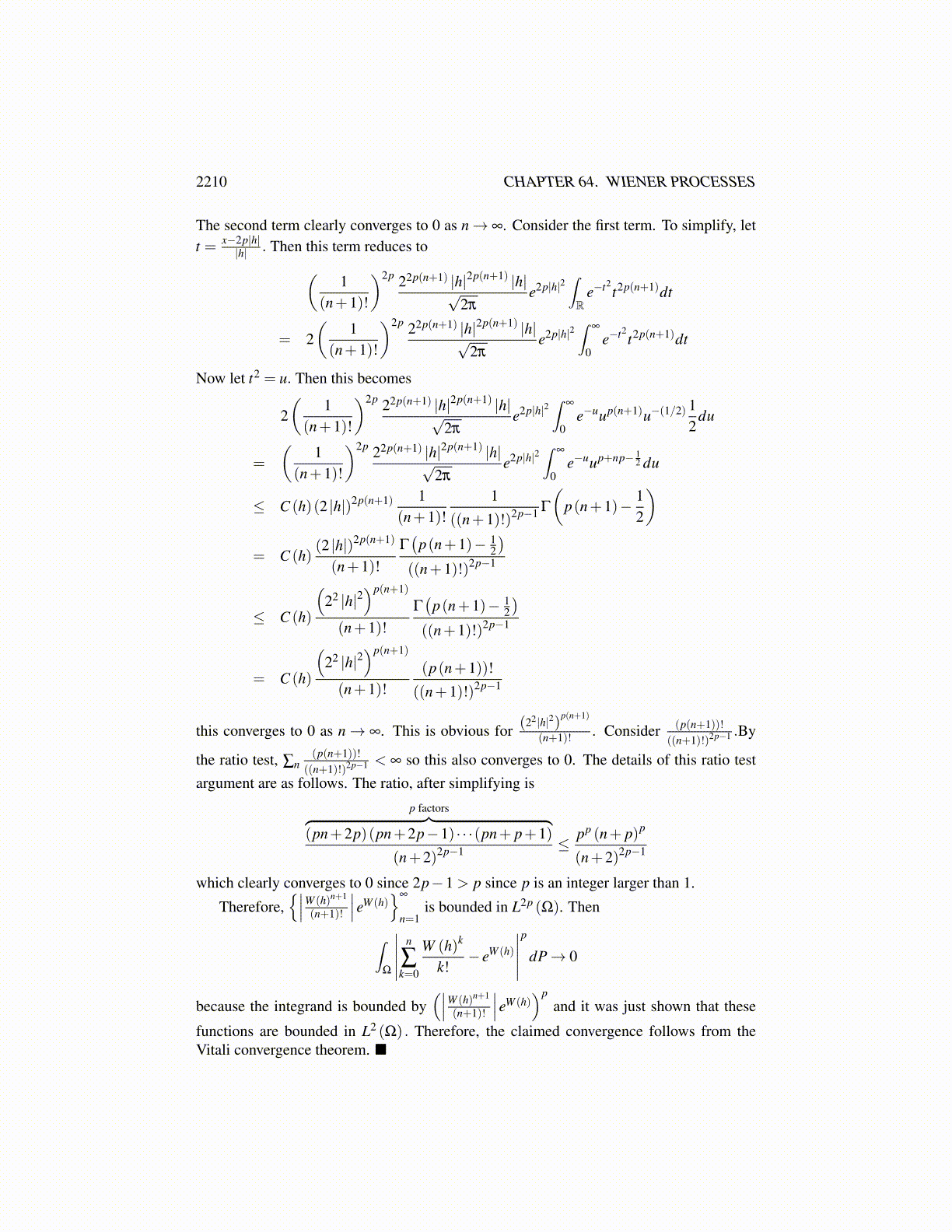
2210 CHAPTER 64. WIENER PROCESSES
=m
∑k=1
dk
∫Rp
f (Y)dνk
where νk (B)≡∫
ΩXDkXB (Y)dP. Now let
νn (B)≡∫
Ω
m
∑k=1
dkXDkXB (Y) =∫
Ω
snXB (Y)dP
It is indexed with n thanks to sn. Then
νn (B) =m
∑k=1
dk
∫Ω
XDkXB (Y)dP =m
∑k=1
dkνk (B)
Hence ∫Ω
f (Y)sndP =∫
Ω
f (Y)m
∑k=1
dkXDk dP =m
∑k=1
dk
∫Rp
f (y)dνk
=∫Rp
f (y)m
∑k=1
dkdνk =∫Rp
f (y)dνn
(sndP = dνn so to speak.) Then let sn (ω) ↑ X (ω) . Clearly νn ≪ ν and so by the RadonNikodym theorem dνn = hndν where hn ↑ 1. It follows from the monotone convergencetheorem that one can pass to a limit in the above and obtain∫
Ω
f (Y)XdP =∫Rp
f (y)dν
The interest here is to let f (Y) ≡ eλ ·Y so f (y) = eλ ·y. To remember this, XdP = dν in asort of sloppy way then the above formula holds.
Lemma 64.6.4 Each eW (h) is in Lp (Ω) for every h ∈ H and for every p≥ 1. In fact,∫Ω
(eW (h)
)pdP =
∫Ω
eW (ph)dP = e12 |ph|2H .
In addition to this,n
∑k=0
W (h)k
k!→ eW (h) in Lp (Ω,F ,P) , p > 1
Proof: It suffices to verify this for all positive integers p. Let p be such an integer. Notethat from the linearity of W,
(eW (h)
)p= epW (h) = eW (ph) and so it suffices to verify that for
each h ∈ H,eW (h) is in L1 (Ω). From Lemma 64.6.3,∫Ω
eW (h)dP =∫R
eydν (y)
where ν (B)≡∫
ΩXB (W (h))dP =
∫RXB (y)dν (y) . In using this lemma, Y =W (h) ,X =
1. Thus∫Ω
eW (h)dP =∫
∞
0ν (ey > λ )dλ =
∫∞
0
1√2π |h|
∫[y>ln(λ )]
e− 1
2y2
|h|2 dydλ ,u = ln(λ ) ,