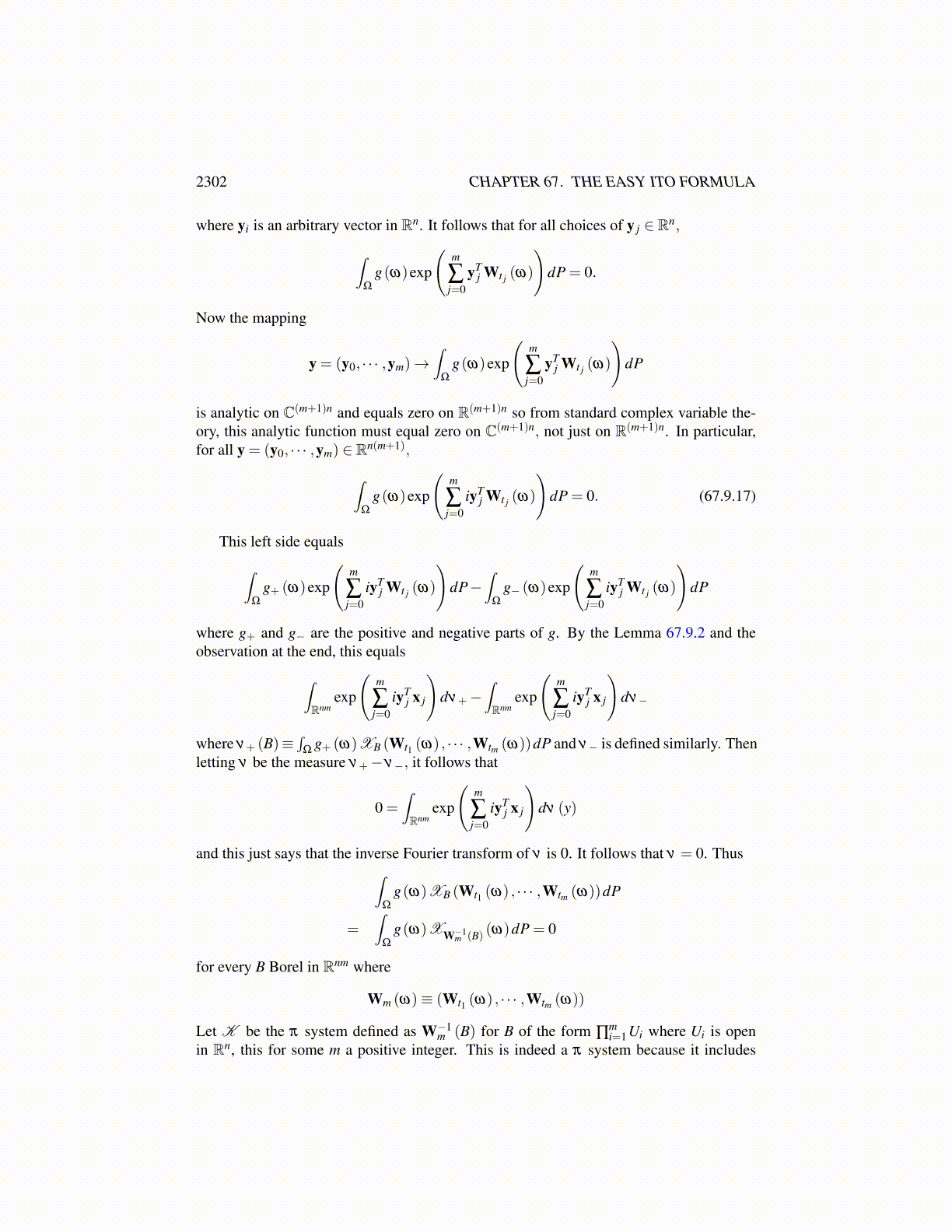
2302 CHAPTER 67. THE EASY ITO FORMULA
Then
νn (B) =m
∑k=1
dk
∫Ω
XDkXB (Y)dP =m
∑k=1
dkµk (B)
Hence ∫Ω
g(Y)sndP =∫
Ω
g(Y)m
∑k=1
dkXDk dP =m
∑k=1
dk
∫Rp
g(y)dµk
=∫Rp
g(y)m
∑k=1
dkdµk =∫Rp
g(y)dνn
Then let sn (ω) ↑ X (ω) . Clearly νn ≪ ν and so by the Radon Nikodym theorem dνn =hndν . Then by the monotone convergence theorem, for any B Borel in Rp,∫
Bhndν = νn (B)≡
∫Ω
sn (ω)XB (Y(ω))dP ↑∫
Ω
X (ω)XB (Y(ω))dP≡ ν (B)
Thus for each B Borel, 0≤ hn ≤ 1 and∫B
hndν → ν (B)
and so hn ↑ 1 ν a.e. Thus, from the above,∫Ω
g(Y)sndP =∫Rp
g(y)dνn =∫Rp
g(y)hn (y)dν
It follows from the monotone convergence theorem that one can pass to a limit in theabove and obtain ∫
Ω
g(Y)XdP =∫Rp
g(y)dν
Note that the same conclusion will hold if the functions are suitably integrable withoutany restriction on the sign. In particular, this will hold if g(y) is bounded. One just con-siders positive and negative parts of real and imaginary parts of g and applies the abovelemma.
LetGt ≡ σ (W(s) : s≤ t)
thus the normal filtration for the Wiener process and the Ito integral and so forth is
Ft = ∩s>tGs
Lemma 67.9.3 Let h be a deterministic step function of the form
h =m−1
∑i=0
aiX[ti,ti+1), tm = t
Then for h of this form, linear combinations of functions of the form
exp(∫ t
0hT dW− 1
2
∫ t
0h ·hdτ
)(67.9.14)
are dense in L2 (Ω,Gt ,P) for each t.