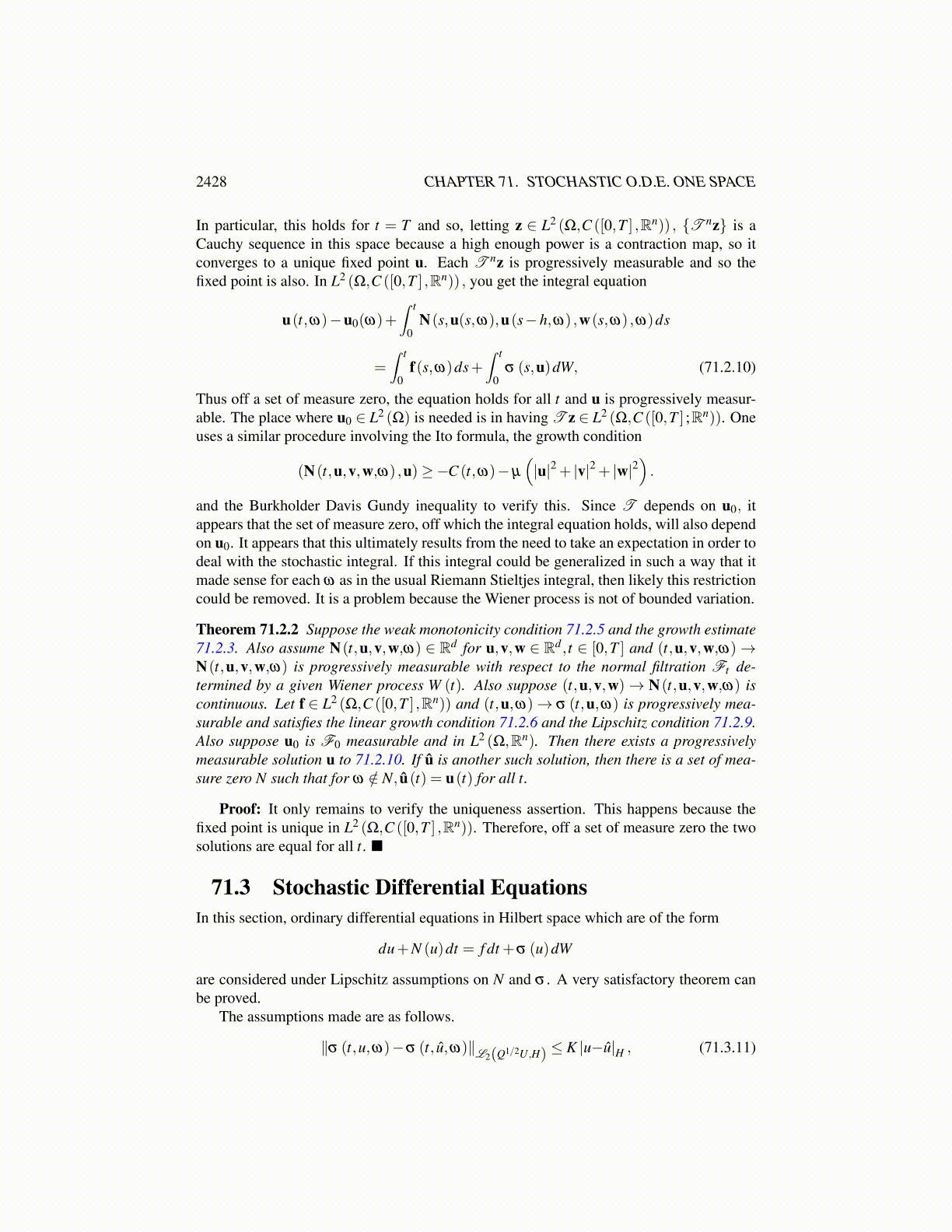
2428 CHAPTER 71. STOCHASTIC O.D.E. ONE SPACE
where u(t) ∈ H a Hilbert space. Consider F (u) = 12 |u|
2 . Also let R denote the Riesz mapfrom H → H ′ such that ⟨Rx,y⟩ ≡ (x,y)H . Then proceding formally, to see what the Itoformula says,
dF = DF (u)du+12
D2F (u)(du,du)+O(du3)
Recall then that du =−Ndt + f dt +ΦdW and so recalling (dW,dW ) = dt,
R(u)(−Ndt + f dt +ΦdW )+12∥Φ∥2 dt
Hence
12|u(t)|2H −
12|u0|2H +
∫ t
0(N,u)H ds− 1
2
∫ t
0∥Φ∥2
L2ds =
∫ t
0( f ,u)ds+
∫ t
0Ru(Φ)dW
The last term is a martingale or local martingale M whose quadratic variation is given by
[M] (t) =∫ t
0∥Φ∥2
L2|u|2 ds
This is all that is of importance in what follows. Therefore, this martingale may be simplydenoted as M (t) in what follows.
Under the assumption 71.2.5 you can include instead of the term∫ t
0 ΦdW, the moregeneral term
∫ t0 σ (s,u,ω)dW . This will be shown by doing the argument and indicating
what extra assumptions are needed as this is done. Let z be progressively measurable andin L2 (Ω;C ([0,T ] ;Rn)). Also assume that σ has linear growth. That is
∥σ (s,u,ω)∥L2≤ a+b |u|Rn (71.2.6)
Then from the above theorem, there exists a unique progressively measurable solution u to
u(t,ω)−u0(ω)+∫ t
0N(s,u(s,ω),u(s−h,ω) ,w(s,ω) ,ω)ds
=∫ t
0f(s,ω)ds+
∫ t
0σ (s,z)dW, (71.2.7)
This holds for all ω . There is no exceptional set needed. Now assume
u0 ∈ L2 (Ω) (71.2.8)
and also a Lipschitz condition
∥σ (s,u,ω)−σ (s, û,ω)∥L2≤ K |u− û| (71.2.9)
Then let u coincide with z and û come from ẑ. Then applying the Ito formula, one canobtain the following for a constant C which does not depend on u, û.
12|u(t)− û(t)|2−C
∫ t
0|u(s)− û(s)|2 ds−K
∫ t
0|u(s)−û(s)|2 ds = M (t)